The perceived end in acquiring technology is marked by the contract. The contract or agreement cloaks its polarized nature; being either very good or torturous for both parties. All too often the contract is not seen as another exercise in due diligence. Commonly, the prospect accepts the negotiated amounts imbedded in the contract and within thirty seconds the prospect is transformed into ‘client’.
In the contract phase of the relationship, one must recognize that the contract represents a huge negotiating piece. Since the contract was prepared by the vendor it is meant to protect the vendor’s self interest. The licensee therefore must exercise their position to ensure their needs are met. The contact sets the stage for how the relationship between the parties will operate in good and bad times.
The contract has two major components, those stipulations expressed in the contract and those implied either within the contract or through external bodies. Due to the very nature of the exchange of intellectual property for compensation, local, national and international laws define the rights of the licensor and the licensee. In the best case, the licensee has technology which supports their organization for decades. On the downside, the licensee is ensnared with financial obligation for technology which they simply cannot use.
From the licensee perspective, the rule when dealing with the contract is having more ‘eyes-on-deck’. Basically the more people who review the agreement increases the probability that the licensee’s needs are met. The agreement review should proceed through multiple iterations addressing issues by way of increasing complexity. As part of the due diligence process, the final review of the agreement should be done by a lawyer who specializes in the type of intellectual property that is being acquired and ensure that contractual nuances are being met.
The appropriate address of intellectual property contract analysis is best served in another forum; however there are key issues the layperson should be aware of: ownership, warranty/support, jurisdiction, and export provisions. Of these issues, and there are many more as depth in the analysis increases, the simplest to address is support and the most complex is export provisions.
The warranty/support issue should be at the forefront of the licensee’s thoughts. Basically, the importance of the contract is at the forefront when the technology breaks: how quickly will the licensor respond and how; will they provide a fix, a patch or a replacement; and how long will they continue to support your technology. Keep in mind that the technology may be jugular to the licensee’s operation and a resolution to an issue should be swift to ensure no loss of business operation. An immediate ‘red-flag’ is where the licensee doesn’t operate a support center during the same hours of operation as the licensor. Another important issue that the licensee should ensure is document is the licensor’s escalation policy for dealing with licensee issues.
On the other end of the spectrum, what does the agreement say about exporting the technology outside of the jurisdiction where it is purchased/licensed? What do federal laws say about the export of the intellectual property? These are issues of paramount importance should the licensee have operations outside of the contract jurisdiction.
The contract/agreement represents the glue that binds the licensor and the licensee. The euphoria at the time of signing can easily become a point of a litigation should things go awry. Take the time, continue your due diligence and if all is done well, you and the licensor will share a ‘two-headed’ coin!
Saturday, October 04, 2008


Wednesday, September 17, 2008
Demystifying Technology Pricing
Once you have gotten to the stage of the technology you need and the vendor from where it will come, the next issue is to determine the price. Interestingly enough the more one delves into technology pricing models the more the reality of no set pricing becomes the norm. How vendors arrive at their price list runs from complex modeling to what the market will bear. However, looking at pricing from the buyer perspective there are some touch points that can greatly affect the price. There are many factors that will drive the price-point for the desired technology; this can be broken down into two main classes, the buyer and the vendor demographics. It is the vendor and the buyer demographics that begin to formulate ‘the price’.
Right from the starting gate, the vendor will need to know the size of the buyer organization, amount of current or intended use of the technology whether or not the buyer will need training or what other technology services will be employed. It is at that point the vendor consults their ‘price list’. Basically this ‘price list’ can be highly scientific or epitomize subjectivity in the wildest sense. The vendor price list could be built on market analysis, profitability or basically random numbers pulled out of the air. The astute buyer will always get the best price once they understand how their chosen vendor has built their ‘price list’.
The main divisional breaks on technology pricing are: hardware/software/consulting and public vendor/private vendor. These main breaks in pricing models will determine how much flexibility the buyer has with getting to a palatable price. These divisional lines sit along a continuum, the most rigid pricing of which is hardware/public company vendor and the least rigid is from software/private companies. The addition of consulting/services places the price for those services more along the continuum, rather than the extremes.
The production of hardware technology is built upon verifiable research and quantifiable components. The vendor is well aware of their variable and fixed costs of production, therefore they are cognizant of their break-even points in production. To this knowledge, add the ‘motivation’ of shareholders as in a public company and the profitability lines will be established; which infers the margins. With these strongholds on pricing, hardware technology from publically traded companies doesn’t lend itself to large discounting.
Where hardware technology organizations provide consulting/services, this is the area where the buyer can negotiate strongest. Very often the hardware vendors will loosen the reins on service margins to maintain hardware margins. To the buyer, keep in mind that empirically most vendors will charge between 2.0 and 3.5 times their cost of providing the service. The buyer’s strongest position comes when the buyer knows the vendor has idle consulting resources; as the vendor has a sunk cost with their labor pool.
The pricing model is radically different in the software technology realm. The production of software bears with it a certain number of hours of planning, programming and ultimately testing. All of these hours are verifiable and quantifiable and therefore a cost of production of the software can be derived. These costs represent fixed or sunk costs, and the company bears these costs whether one software copy is sold or one million copies are sold. Notice how different this is from hardware pricing; with software the costs are recognized when the software is built – no matter how many copies are sold. While with hardware, there is a certain fixed up front cost on the research side, however once in production each until attracts a cost. The buyer is more likely to achieve a better price if they know the vendor has considerable inventory, new models are about to be released or the purchase time is nearing the vendors fiscal year end.
The buyer should now recognize that the pricing points for software have tremendously more flexibility than those of hardware purchases. This price point flexibility is further enhanced whether the software company is public or private. Publically traded software companies have a strong external influence to meet shareholder expectations and therefore are less likely to entertain or sustain deep discounting; this is where the demographics of the purchasing organization can have tremendous influence. For the buyer, the best time to get to the right price would be through knowing about the vendor. The buyer should make it a point to find out the vendor’s year end, often four weeks to the vendor’s year end, and less so near quarter end, will make the difference between the ‘price list’ and the ‘best price’.
The buyer’s best pricing will be derived from privately held software companies. These companies tend to be smaller and often do not have a grasp of the cost of software production. To that end, they could essentially discount the software to nothing simply to ‘get the deal’. Where the buyer’s switching costs are high, a nil price on the software shackles the buyer to the vendor. This shackled relationship may or may not be in the best interest of the buyer and it must be a source of further investigation. Since the privately held enterprise may not be legislated by strong external forces, like shareholders, the concept of quarter and year-end periods are not that important to getting to the ‘right price’.
More often with software companies than with hardware companies, a considerable amount of revenue is the result of additional services. To the software company, consulting and services may be their only sustenance between sales. The services could be anything from training, data conversion to expert consulting. Like with services provided by hardware vendors, software vendors tend to offer services at 2.0 to 3.5 times the costs they incur in providing those services. As these costs represent sunk costs to the software vendor just like with the hardware vendor; this becomes an area where the buyer can realize the greatest savings.
Your responsibility to your organization goes beyond getting the right tools; it is getting the right tools, the right training and all at the right price. Recognize that the price list is only a suggestion and the right price comes down to how well the buyer and vendor can ‘work’ together on closing the deal. Keep in mind there are so many contributing factors to price; which far exceed the elementary view of “price”, as professed by economist Adam Smith.
“The real price of every thing ... is the toil and trouble of acquiring it as influenced by its scarcity”.
Adam Smith
The Wealth of Nations (1776)
Wednesday, September 03, 2008
When two becomes one; partnering?
The acquisition of enterprise level software or simply software for a specific use in one’s organization is much more than dropping the Amex card at Best Buy. It never ceases to amaze me how such enormous, even jugular, purchases are handled at a very cursory level. More consideration is spent on the price and the contact than on the relationship. That is like spending more time negotiating the price of the car than choosing the car!
I am not sure where the problem lies, whether software companies have commoditized their product offering so the only differentiating factor is the price or the buyer is simply not connected with what they are getting involved with. Organizations really need to slow down on their technology acquisitions and realize what they are doing is forming a relationship with the vendor.
A relationship is a connection between two parties; they can take many different forms and are unpredictable in their duration. However, the vendor purchaser relationship, especially of enterprise technology, should be viewed as a major undertaking. From the purchaser’s perspective, they are entrusting the vendor with vital elements of their operation both now and into the future. Therefore, there should be many many more questions other than price. The vendor, who is in the business of building the technology, must realize that they must stay attuned to their customer’s needs and therefore not only follow the trends but strive to be ahead of the curve.
Organizations who fail to under take a process of due diligence when acquiring technology are really compromising the competitive advantage of their organization both now and into the future. Keep in mind, price and contracts are static. How the vendor works at the relationship will go on long after the contact is signed and monies paid.
Ideally organizations should connect with 3-5 vendors who produce the type of products/functionality they are interested in. Then, as discussed last week, have a list of requirements graded 1-5, must have to a nice-to-have. At this point, the firm should look at the top 2-3 vendors and begin the due diligence process.
The due diligence process should quickly reveal whether the technology vendor is focused on their products of today and if they have vision of tomorrow, or even if they will make it to tomorrow. Remember the market leader today could be the market laggard of tomorrow. Following are a list of some major things the purchaser should rank vendors by:
The company’s economic viability now and into the short term; this is readily accessible with credit reports or public filings if they are a public company. What are the plans of the future of the company (product diversification, internationalization, etc)?
What are the skills, experience and composition of the vendor’s staff? What is the staff turnover and why?
What is the vendor’s current technology base? What are their plans for adopting new technology platforms?
How many new releases, not upgrades or bug fixes, the vendor produces per year? Who determines what goes into the future release? Is new functionality confirmed by a consensus or a regulatory board?
Is the vendor certified with the tools or processes they are using (ISO, Microsoft, SAP, etc)?
What is the timeliness on which the vendor will respond to a warranty issue? How are warranty issues reported?
Is the vendor’s customer service available when my business is open?
Does the vendor provide project management to get the technology up and running at my facility? If so, what type of training/certification does the project management team require before they are able to go out in the field? Does the vendor offer configuration services to ensure that the technology will work properly in my organization?
The type of questions one could ask could go ad infinitum, however, it is imperative to get a good understanding of who your technology provider is and will they be around to provide you solutions into the future. Before either side begins to think of the contract, they must understand if their aspirations and dreams are in alignment anything less is a recipe for a costly disaster.
Remember negotiating a contract is easy; cutting a check is easier – trying to get broken technology fixed – will cripple your organization one way or another!
Sunday, August 24, 2008
Thought, Actions, ROI – Almost Inseparable
With all of the frustrations conjured up each and everyday because of computers and software, one would be very hard pressed to confess they would rather return to a world without technology. The conveniences of modern day living is a direct result of technology. With all of its problems, software technology brings value to every use, to some degree. This value can be tied directly to the choices made as to the type of technology and its implementation.
Over the next week close to three thousand people will converge on Dallas Texas for the International Legal Technology Association (ILTA) annual conference. This educational based forum affords leaders from today’s law practices to acquire and share their knowledge with their peers. As an added benefit the forum presents an opportunity for these leaders to meet many of the companies who furnish their organizations with software technology.
With so many vendors presenting their latest solutions, one is very hard pressed to identify the right fit of software for their organization. This dilemma is easily dissected into its component parts. Vendors will proudly profess their value proposition; the value their solution brings to the market. This ‘value’ is demonstrated in all of their literature and hidden in their graphics, logos, presentation and even in their references. Very simply all software will provide user some value, even those camouflaging old technology.
With three or more vendors touting their value, it becomes difficult to select the ‘right’ solution. Or does it? Software selection is a two part process. The first and easiest part is to understand what is available in the market place. The second step in selecting the right fit is in understanding the environment where the solution will be used. This is the area where most organizations have and continue to fail.
Know thy self written by Socrates about 350 B.C. speak volumes on why some organizations fail and others succeed in implementing the SAME solution. This is also the reason why today’s market is filled with consultants selling their expertise under the realm of Six Sigma, Lean Manufacturing, BPR, JIT manufacturing and the list goes on. Armed with the knowledge of what is available, the leader should critically examine their current process which will lead to the ‘right’ fit.
A critical examination is more than a cursory review of how bills get created or how checks are approved. It is a full documentation of the entire process, followed by a critical examination asking ‘why’ at each step; why do we do ‘this’ like this? Six Sigma methodologies refer to this as the DMAIC sub-process. The sub process is outlined as: define measure, analyze, improve and control. The belted consultant would critically review the process asking ‘why’ at each step with a view to make the process more efficient and less prone to errors.
The greatest return on any software solution will not be derived by the solution itself but rather by the revising of the underlying business process. Overlaying a historical business process with new technology only acts to speed up the arrival at the ROI glass ceiling. There are so many examples of organizations changing the tools but keeping the old process. Take for instance the Dvorak Keyboard of the early 1900’s which allowed for higher typing speeds. However it was replaced by the QWERTY Keyboard because of mechanical constraints of manual typewriters. Notice, in today’s age we have yet to return to the Dvorak keyboard; we are too entrenched in history. The world of software is no different; firms continue to muddle through software acquisition and be satisfied with their 10-15% ROI, because of the mentality that the process has always been done this way and we cannot change it. However, the astute firm who reexamines their entire process, making the appropriate changes to streamline their process and enhancing the new technology, enjoys the 40-80% ROI. In the five years from 1995-2000, General Electric learned firsthand how the act of reviewing each process with a critical eye before launching yielded a $10 billion benefit!
A new look at an old process will immediately reveal historical inefficiencies. Once the process is re-scripted, then one is better prepared to ask the critical questions necessary to separate one solution provider from the next; this is what clarifies the difference between average and extraordinary returns on investment. So as you stroll through the vendor halls listening to vendor value propositions, recognize that you, and only you, control your true ROI with any new solution!
Thursday, August 14, 2008
My Caffeine…My Way!
Over the past several weeks, I have received numerous questions surrounding software selection and licensing. Therefore, I feel compelled to spend the next few weeks demystifying this entity we refer to as “software.” This will be accomplished to the extent that we get the solution we need, how and when we need it, as well as including some of the common ‘gotchas’ associated with acquiring software.
It is impossible to make it through a single day without using some type of software or even being the beneficiary of it. Software is such a part of our daily life whether we see it or not. It starts with the electricity and running of water which makes its way into our homes, the alarm clock in the morning, the cars we drive, elevators we ride, and even into the production and storage of the food we eat. But what is software? The term ‘software’ first made its presence into the English language in 1958. Since then it has become a widely used term, but the definition is somewhat illusive. Merriam-Webster defines it as: “the entire set of programs, procedures, and related documentation associated with a system and especially a computer system; contrasted with hardware.” While other dictionaries define it as anything from “not hardware” to “a codified set of commands that direct microprocessors to perform certain functions”, what ever the real meaning is. Software makes things in our lives work, be it phones or electricity; we have conveniences because of software.
During the first thirty years of its life, software meant ‘you get what you get and you can’t throw a fit!’ Because for a long time people lived with the reality that any automation was better than none at all since the manual approach was much more difficult. However, as benefits of software were recognized more people entered the software development field, which resulted in new and innovative technologies being produced; ultimately making their way to market. The market turned into a ‘you get what you want’ arena; but at a price. This ‘having it my way’ fed the software production engine more and more fuel through the 1980’s to today. The resounding theme through all of this expansion was, you have to pay for what you want. As each product offered different strengths, one would have to choose the product that met the highest number of their functionality need; then put out the money. They often paid the price for functionalities they didn’t need or even want, simply because that was how the product was packaged.
From the late 1960’s the costs of purchasing (licensing) software was very subjective, with a common theme of ‘expensive’. Essentially software companies were on the pharmaceutical model, recoup all the R&D costs per unit sold. Sometimes their model was flawed and the company went broke, other times the model was profitable and the company flourished. As more firms caught on, the competitive pressures clarified the model and produced other options for recouping the R&D costs.
Today there are a plethora of options to get the needed functionality you need at the ‘right’ price. Following are a few of the most popular models.
The Classical Model has the user paying a lump some amount of money for the software package. This package would often include other components that the user may or may not want. Sometimes in this model there are additional fees, such as support and maintenance. If it is consumer software, the price on the package is the price you pay. However, if it is enterprise software, the book price is the starting point for negotiation.
A progressive variant of the Classical Model is known as the SaaS Model. The acronym stands for Software as a Service. Here the user only pays for the use of the software when and if they need it. This model began gaining popularity after Microsoft launched the SaaS model in 2000 for its Office Suite of products. This allowed organizations to ‘rent’ software applications on an as needed basis; the savings were phenomenal! No longer did firms need to buy (license) the entire suite of Office Professional, they could, a la carte, satisfy their users needs.
In the early 20th century, there was a rise of the Free Culture and the Open Source Culture. The Free Culture created the concepts of Freeware, Shareware and Public Domain software to the world. The Free Culture was, and continues to be, a hard core group of software engineers who, through different motivations, goal is to put solutions into the world. Freeware tends to provide specific functionality, such as converting MS Word documents into another format, and is made available to the public for a voluntary fee. Shareware is a little more advanced than Freeware in that it has limited capability and is offered on trial, where the full version can be purchased at any time. Public domain software is completely free for anyone to use, however they want.
It was the Free Culture and the Public Domain movement that gave rise to the Open Source Model. In this model, software is provided free or at a nominal charge to the public, more often than not, under a licensing agreement, however, the user has access to the ‘software code’ which allows them to make changes to the software. With the Open Source Model, the user can now add functionality that they specifically need. Until this point, adding ‘your own’ functionality never existed. Another progressive thought introduced with Open Source was that newly added functionality must be returned to the public domain, where everyone can enjoy the new functionalities. According to the Law & Life: Silicon Valley blog posting of April 4, 2008; by 2012, 90% of businesses will use the Open Source Model in some capacity.
In addition to the diversity of software features available one must recognize there is also diversity in getting what you need. Over the coming weeks, the journey of selecting YOUR software solution and how to acquire YOUR solution will be addressed. Recognize that your working environment isn’t rigid any more; you have options! The classical model often binds you to a ‘packaged solution, the SaaS model allows you get ‘what you need, when you need it’ for a fee, while the Free Culture presents the low or no cost alternatives. With that said your email needn’t originate from within a suite of products; it could be used ‘as and when needed’ or can be the Java Open (Source) Office completely free solution.
I am glad I can have my mocha java latte, with cinnamon!
Thursday, August 07, 2008
Credits Calling from the Abyss
It is amazing that the life blood of modern day commerce rests on a system devised over 500 years ago. In 1494, Luca Pacioli documented the technique of double-entry bookkeeping, and from then became know as the ‘Father of Accounting’. One could only speculate that his reasoning for this technique was to accurately reflect the transactions of a business at any point in time. Over the years the complexity in commerce imposed tremendous challenges to double-entry bookkeeping; however the Pacioli model remained steadfast through generations.
Today’s methods of recording transactions are tremendously more complex than that practiced in the early 1500’s. However, accounting bodies all over the world actively postulate the best and fairest means by which to record complex transactions. With the rapid globalization of commerce, the International Accounting Standards Board works tirelessly to instill some order in complex global transactions.
Interestingly enough the bulk of the accounting problems faced by today’s organizations are not rooted in complex transactions, but rather the most rudimentary type of transactions. Over the past month, many organizations shared some of the difficulties facing their accounting departments. The two most prevalent difficulties were billing and cash receipts. Although both of these transactions seem so very simple; today’s business has created a wealth of unnecessary complexity from simplicity.
Payments come into all organizations by way of some type of negotiable instrument. For the most part, the person empowered to deal with these payments have been trained to know what to do. Often this training is ‘hand-me-down’ knowledge and is therefore often diluted. Very simply the negotiable instrument should be placed into the bank and the payment recorded in the organization’s financial records. However, I have seen organizations hold onto payments until they can ‘figure out’ how to treat them for accounting purposes; sometimes days if not weeks. Somehow organizations don’t realize that securing the payments and recording the receipt of funds are two very separate functions. The banking of negotiable instruments is a treasury function and is of paramount importance. The second most important activity is properly recording the receipt of funds. It is in the recording of these payments that organizations have conjured up a huge amount of complexity.
The best clarifying agent for the recording of cash receipts comes directly from accounting principles, known as GAAP. The one differentiating factor in dealing with incoming cash receipts is to determined if: a) revenue is earned and therefore payment due, b) or revenue is not earned and payment is not due. If the customer has remitted payment for goods or services rendered, revenue was earned and therefore the payment is due. Therefore recording of the receipt of funds becomes very simple; relieve the customer’s outstanding debt in the organization’s ledger. Even something this simple causes organizations anxiety. A moment spent examining the customer’s payment should provide insight to what bill they are paying. If this information is not readily apparent, it is the responsibility of accounting team to make contact with the customer to get the correct information. This simple customer exercise ensures that both the client’s records and the organization’s records properly reflect the transaction.
The receipt of payment when revenue is not earned and payment is not due, is experienced by many organizations in many different markets. In this situation, the customer is advancing payment for a specific purpose, often to be in compliance with the terms of engagement. Depending on the type of organization these funds could bring with them a whole host of special rules. In manufacturing or construction, these funds could be a deposit on an upcoming invoice. Therefore in the financial systems for these types of organizations there would be a method to reflect the receipt of these funds as a credit on the customer’s account.
In more service type establishments such as the practice of law, land title agencies, or real estate organizations there are specific rules as to the treatment of non-earned customer receipts. Each of these types of organizations must follow protocols as determined by their governing body. Often these rules differ by local jurisdictions and definitely by country. In my career I have had the greatest exposure to the cash receipts rules of legal practices. From my experience, commonwealth countries have the strictest rules by which client monies must be managed. In these countries essentially all non-earned cash receipts must be segregated from the firm’s operating funds accounting and a sub-ledger for each client must be maintained; in exceptional detail.
Law firms’ cash receipts can be sifted down to three main three types: a) payment for outstanding bills, b) payment for disbursement on a transaction, and c) payment as a retainer to an engagement. Very simply, the payments received are either in consideration of a bill or are not. Funds received as part of transaction type b or c create a tremendous amount of frustrations for most US firms simply because they are not related to a bill.
The treatment of unearned payments (b & c) is really very simple. The American Bar Association (ABA) has dedicated an entire section of their website to addressing these types of payments http://www.abanet.org/legalservices/iolta/. The site also provides links to local state bar association statutes and even foreign statues for dealing with these types of transactions. In addition to the ABA’s treatment there is an excellent book that adds clarity to managing law firm cash receipts: Accounting in a Law Office by Kenneth Laundy. In his book, Laundy demystifies all of the theories between earned and not earned cash receipts and their related treatment to remain in compliance with statutes. Firms must understand that unearned funds are NOT the property of the firm. Therefore they must be segregated from the firm’s operating funds and managed through the firm’s billing system sub-ledgers, by client. With that said a retainer is not earned revenue until billable hours or disbursements are added to the client’s ledger and a bill is produced. Equally, just as receipts as part of a settlement to litigation are NOT the property of the firm and therefore must NOT be comingled with the firm’s funds.
Cash receipts are the most fundamental part of any business. Their management should be as easy as Pacioli documented in 1494, they shouldn’t get lost in the abyss of complexities. There are governing bodies abound that provide direction for record keeping. So, simply deposit the instrument into a bank, properly record the transaction in the financial ledgers and… move on!
Wednesday, July 30, 2008
Time to Ride
Over the last several weeks all of the pieces to an effective credit policy were formulated. By now, the astute person would have this framework awaiting approval. Policies are essentially useless unless they are put into action to initiate change. The beginning of change comes with the collection policy and related efforts.
The collection policy essentially outlines the systematic steps that must be applied to manage the accounts receivable. Recall that the credit policy established the guidelines on which the organization will manage their client relationships. The collection policy starts the moment accounts receivable is generated in the relationship. If you are following this process closely, the question you should have is, “How is inventory (work in progress) managed?” The management of inventory is defined in the assessment of client risk, as it is the sum of inventory and accounts receivable that designates the investment in the client relationship.
After years of research into the reasons for delinquent accounts receivable, the causes can be reduced to: relationship, billing and/or economic. To the credit/collections professional, these issues can all be resolved. The easiest issue to resolve is that of billing. A simple flow audit through the organization will unearth some of the issues surrounding billing. For a bill to be accepted, it must conform to the terms of the engagement. i.e. meet the terms of the Purchase Order, or engagement letter. The bill must clearly outline what goods and services are being billed for, with identification of the timeframe the bill covers. Most importantly the bill must identify a specific recipient, date, when payment is due and any supporting documentation. One of the faux pas with professional services firms is the use of the caption ‘payable upon receipt’. Turning to Webster for clarification, payable can be defined as, “capable of being or liable to be paid’. Sounds a little illusive, how about “payment due upon receipt”, which removes any ambiguity!
Delinquent receivables are the result of client related economic issues, and this is a tremendous opportunity for the organization to establish client good will as well as solidify a long term relationship. Economic misfortunes may or may not be the result of client actions. It is the astute firm that can use the situation to complete or continue the engagement while ensuring payment is forthcoming. This is where the savvy collection sense of the credit department can leap in to action. In so doing, provide payment options for the client so as to maintain the relationship.
The most difficult issue surrounding delinquent receivables occurs when there is a relationship breakdown. When this occurs, the client has essentially professed their position with their check book by silently stating, “I am not paying you!” At this point, firms have options. They could simply walk away from the receivable, otherwise known as a write off. The firm could turn the account to an outside firm that may litigate and possibly recover some of the amounts. This option brings a significantly reduced payment and the possibility for counter claims. Therefore, the firm must be sure that they did everything according to the original engagement. Can you see why it is so important to get the relationship off the ground correctly? The last option is for the client representative to go back to the client and attempt to rebuild the relationship. Rebuilding the relationship isn’t negotiating a settlement, it is accepting that a relationship has two sides and it took two to break up the relationship.
What ever the cause of the delinquent receivable, it is the task of the credit department to flush it out and get the cash flowing. There has been much written in this area, sadly much of it unprofessional. The best piece of advice in this area is to become familiar with the credit/collections laws in your jurisdiction. In the United States credit/collections falls under the, Fair Debt Collection Practices Act. Keep in mind that there are or could be laws for local jurisdictions based on your type of business. A good layperson’s resource written for the US market is The Credit & Collection Manual (CCM), put out by the Credit Research Foundation. This text packs a tremendous amount of resource information in a small handy text. It is a definite must have for any credit department desk.
Regardless of the cause of the delinquent receivable, the first action is to flush out its root cause. The best way to do this is by way of monthly statements of account. For many organizations the sending of monthly statements is deemed to be a waste of time and postage. However, the recipient of a statement can quickly identify what they owe and discrepancies in the billing; whether they choose to act on it or not. For a publically traded company this information is paramount, as a reconciliation of payables is one of the areas investigated during the annual audit. Sending statements is even more important for law firms’ clients. For clients who require an annual audit, information as to the involvement in a lawsuit is paramount, and a statement from the law firm makes it clear to the auditors.
In addition to the monthly statement, the credit department must make contact with the client. According to the CCM, computer generated form letters provide substantial saving in time and expense while being marginally effective. Keep in mind, in light of an economic or relationship distress a ‘nasty-gram’ letter won’t open a dialogue to getting the issue resolved and receiving payment. The text goes on to say that individually prepared collections letters only give the recipient evidence that someone is monitoring the account, but the results are somewhat the same. Collections letters will only generate payment when the recipient simply hasn’t received the billing or truly wants to pay the account but has simply fallen behind. This means of communication isn’t really aimed at problem resolution, it is simply and audit trail toward litigation.
The best approach to flushing out an issue and begin problem resolution is direct telephone contact. This approach is heavily encapsulated in laws; therefore it is only for those well versed in collections laws. Ed Poll in his book, Collecting Your Fee, refers to this time as dial and smile. When done correctly credit professionals will flush out the root cause of the nonpayment, relationship or economic, and thereby begin to formulate a resolution.
There is no mystery to getting your bills paid; it all comes down to having a plan. The plan begins with understanding your affinity for risk, then building a policy for managing the risk. From there, gauge every client relationship against your risk profile while making sure both sides knows what is expected in the relationship. Do the best job you can to fulfill your obligations and have a procedure for managing those few accounts that become delinquent.
To most organizations, the concept of change seems like hiking Mt. Everest. Firms can continue along doing what they have been doing and expecting the same results – that is insanity. Change takes courage, vision and determination. The fork in the road must not be an obstacle, but the chance for a new beginning – choose a direction and let’s ride!
“Insanity: doing the same thing over and over again and expecting different results.” Albert Einstein
“When you get to a fork in the road, take it!” Yogi Berra
"When you look for excuses not to change...they will be found. It takes courage, determination and fortitude to get off the merry go round." S A Miller
Tuesday, July 22, 2008
Want GiGo free Accounts Receivable?
The last few weeks were spent building the foundation of a credit policy. If one were meticulous and honest in working through the steps, you would be close to a policy that now reflects the organization’s affinity for risk and one that would form the basis of a collections policy. Although the organization owns the client receivable and work in progress, certain individuals must accept responsibility to ensure the inventory is maintained according to policy. This final contribution on building a credit policy focuses the client and the inventory custodian; the credit department.
Contrary to what may be said, people show their likes and dislikes by how they spend their money. Essentially, they buy from people they like. If the bond doesn’t exist, a sale, no matter the price, isn’t forthcoming. Ed Poll in, Collecting Your Fee, sums it up very well with: You can judge the quality of a relationship by the way it ends…a client who genuinely respects you and the work you did will pay your bill in a timely manner. For me, that statement says it all, barring extenuating circumstances on the client side. There are two ways to achieve and maintain that respect, in order to facilitate payment by establishing the foundation for a good relationship from the very beginning, the first meeting. Then once the relationship is established, open regular communication is essential for maintaining trust.
It is during the very first meeting that the professional must establish the foundation for the relationship. Here is where information is exchanged, including costs, fees, terms of payments, and terms of engagement which must all be discussed and documented. It is also the time in which the professional must seek information about the prospect. PROSPECT. The person on the other side of the desk is a Prospect until such time as they meet the organization’s criteria of acceptance into “client-hood”. It is for this reason that he professional must obtain a completed credit application during the meeting, as this is the only means by which the organization can assess where the Prospect fits regarding the firm’s affinity for risk. At the end of the meeting, the professional should have explained the nature of the engagement and provide all discussed to the Prospect, either as an engagement letter or proposal; which must be signed and returned. The professional should have a fully completed and signed credit report.
The credit report form provides core insight into the Prospect’s business; their inherent risk. At this point, the firm must quantify the risk and compare it to their affinity for risk. The process by which this is done was discussed earlier in Crystallizing Goals. The part of the organization that is responsible for making this determination is – the credit department. This responsibility must be clearly documented in the credit policy. Depending on the size and complexity of the organization this section may involve a varying degree of detail. By way of example, here are a couple of options that will seed thought:
The credit department establishes credit limits for all prospects and active clients. These limits are based on D&B or TRW ratings, credit references, financial statements, security, or other information obtained directly from the applicants. The credit department must review large client investments on a periodic basis. All limits are subject to revision, based on changing levels of credit worthiness. Only executive management has the authority to override limits established by the credit department. All overrides must be fully documented and the requesting professional is fully responsible for their collection.
Or
Professionals will obtain a completed and signed firm designated credit application from each prospect. This will contain bank reference and three trade references. Through due process, the credit department will determine the prospect’s ability to pay and the level of risk they pose should they become clients. Should the prospect be accepted as a client, a credit limit will be assigned through the use of scoring tools and techniques. Where the professional determines the credit limit is insufficient for the engagement, the prospect must provide 2 years of financial statements or must maintain, on deposit, the equivalent of 1/3 of the expected cost of the engagement. Only executive management can override this policy.
Having a clear delineation of responsibility for the credit department, the professional and the executive officer ensures that the credit policy is adhered to. With the sign off on the entire policy, all people in the organization will act to ensure a consistent approach for dealing with clients. Your AR is a direct reflection of your organization, if it is full of delinquent garbage AR, you put it there through your practices. Only you can stop the build up of garbage AR – build a garbage-free client portfolio!
In closing,
"When you look for excuses not to change...they will be found. It takes courage, determination and fortitude to get off the merry go round"
Organizations are not the victims of their delinquent clients. You and your organization cause your collections problems by not telling your clients from the beginning what you expect from them. Ed Poll
Monday, July 14, 2008
Who’s on First?
To continue with the series of building a credit policy, identifying who is on first is the initial step in beginning to gel the entire policy into a workable procedure. Previously, we outlined the mission of credit within the organization, and then we examined risk and the organization’s affinity to risk. This exercise has set the foundation for what is to follow, integrating the foundation into the structure.
Identifying and empowering the group who will transform the written policy to a way of life within the organization is the most important part of the credit policy. How the responsibility and authority is divided will either produce a highly effective credit department or a serious cost burden on the organization. Senior management, at this point, must clearly define the credit authority and responsibility of the chosen individual or group. Once established, management must uphold the decision of the credit group throughout the entire management infrastructure. If the credit responsibility and authority is not held steadfast by senior management, the credit function will be riddled with squabbling, poor morale, and horrid results.
Ideally, the credit function should report to the most senior of management; treasurer and / or finance committee. At this level of authority, the decision makers have already established the organization’s affinity for risk. Therefore, they must be the body that determines if the organization should accept an engagement for a client which poses a higher than acceptable amount of credit risk. Following are examples of how the credit responsibility section of the credit policy can be worded.
The credit department reports to the office of the treasurer (managing partner); it includes all functions relating to the extension of credit, collections and cash application. The credit manager establishes all credit limits, has final authority to hold or release all engagements when credit problems exist, decides when credit privileges should be revoked and decides when formal credit activity should be initiated.
Recognizing that certain engagements can be beneficial to the organization, the policy could carve out sections that cap credit limits to the credit department and permit management some slack in accepting the engagement. An example for which as follows:
The credit department reports to the office of the treasurer (managing partner). The credit manager may establish credit limits up to $ XX,XXX, and the manager may delegate up to $X,XXX of authority to other credit personnel. Higher limits MUST be approved by the office of the treasurer (managing partner). Those parties requesting higher credit limits than established by the credit department must submit a comprehensive business model as the amount of credit requested, terms of payment and means by which the credit risk is mitigated to firm established limits. In the event an engagement is being withheld because of credit problems, all parties including the office of the treasurer (managing partner), must meet to gain consensus on a solution.
The clarity and authority by which this section of the policy is written will determine the effectiveness of the credit function in the organization. Organizations need to realize that they needn’t accept every engagement. It is interesting to witness the number of organizations that accept engagements from clients who have a higher probability of default than making payment terms. Organizations fail to internalize that doing work for which no payment will be received is known as ‘charity’. As mentioned previously and will be again, the suggestion isn’t to shun these engagements, but rather build a payment arrangement, through retainers, COD etcetera that will allow the organization to accept the engagement through the mitigation of risk to an acceptable level.
There are many tools available to the credit manager and the organization that will allow them to mitigate credit risk while accepting less than sterling engagements. However, the first step is to relinquish any ambiguity of credit responsibility and know definitively ‘who’ is on first!
Tuesday, July 01, 2008
Crystallizing Goals
Continuing on the theme of building a credit policy, once the firm has a feel of their affinity for risk the next step is to understand the client dynamic. As was presented in the last contribution, clients bring to the firm a certain level of inherent risk. For the most part, the amount of inherent risk is unknown to the firm. However, there are tools in the market that will give insight into the nature of the client. Although your client profile may appear like:
 In reality, each of the above bands hides carries with it the probability of default as given by:
 With the firm’s understanding of its affinity to market and inherent risk, the goals of the credit policy can be established. Miller, in How to Write a Credit Policy, contends that one can establish true numerical goals or more fluid goals, but I believe the true numeric goals bind the organization to a dedicated practice of receivables management.
A true numeric type goal is as follows:
Our goals are to limit bad debts to X% of billings, Days Sales Outstanding to Y days, and receivables agings to no more than Z% beyond 60 days.
Alternatively, the more fluid type goal is as follows:
The credit department strives to meet goals, established by senior management, that relate to bad debts, receivable agings and Days Sales Outstanding.
Although goals change, having a clear numerical definition for the credit department and the firm will establish a clear commitment to the credit team and the entire firm. Once this goal is established, the firm should undertake to build a credit application. The credit application is the first means by which the firm obtains financial insight into the client – the inherent risk. There are a plethora of examples on how to build a credit application. Ed Poll, in Collecting Your Fee, provides a very simplified yet very functional client intake/credit application form. The information to be captured must include, at minimum: Full legal name, address, telephone/fax, type of company, tax id, owner/manager information, SIC number, trade references, Bank References and signature of the prospect/client to accept financial responsibility of invoices. For professional services organizations, this information should be included in the engagement letter. This letter must fully document the type of relationship, firm policies on billings and when payment is due, firm contacts, who will be working on the file, and billable rates.
With this information in hand and concurrent with a conflicts check, the firm should undertake a credit check of the prospect. The credit check will determine if the prospect’s ability to pay is in alignment with the firm’s goals and ultimately the firm’s affinity for risk. The first step in gaining insight into the prospect is by way of a credit report. The credit report is a very powerful tool that will give the firm insight into the prospect. The three key credit reporting agencies in the North American market are: Dun & Bradstreet (D&B®), Experian, and Equifax. Although these companies use different algorithms to arrive at their metrics, the metrics you receive are very close amongst the three companies. Using the Dun & Bradstreet system, the following information will be included.
Paydex Score
The Paydex® score is a unique, dollar-weighted indicator that provides an instant overview of how a prospect has paid bills in the past, and how they are likely to pay bills in the future. This is a very important score when it comes to being approved for credit terms or financing. The Paydex® is a 1-100 dollar weighted numerical score of payment performance, calculated using up to 875 payment experiences from trade references reporting into D&B®. Following is the scale and legend.
 Therefore if the prospect is slow 90 days and the firm’s policy is 60 days, the first red flag should go up. It doesn’t mean that the firm should not take the prospect on as a client, but rather alter the terms of engagement understanding the client’s past behavior. This may include a larger retainer than normal or more frequent billing with the stipulation that all invoices are due immediately.
In addition to the Paydex information, all credit reporting agencies will provide information on the prospect's collections history, financial statements and if it has ever suffered any liens or judgments. This information will provide the firm a good understanding of how they should anticipate the client behaving when faced with the firm’s billings. One of the pieces of information that most corporate environments find most helpful is the overall rating. This information essentially ties together all of the information provided by the prospect into an overall rating. The overall D&B rating is as follows:

In reality, each of the above bands hides carries with it the probability of default as given by: With the firm’s understanding of its affinity to market and inherent risk, the goals of the credit policy can be established. Miller, in How to Write a Credit Policy, contends that one can establish true numerical goals or more fluid goals, but I believe the true numeric goals bind the organization to a dedicated practice of receivables management.A true numeric type goal is as follows:
Our goals are to limit bad debts to X% of billings, Days Sales Outstanding to Y days, and receivables agings to no more than Z% beyond 60 days.
Alternatively, the more fluid type goal is as follows:
The credit department strives to meet goals, established by senior management, that relate to bad debts, receivable agings and Days Sales Outstanding.
Although goals change, having a clear numerical definition for the credit department and the firm will establish a clear commitment to the credit team and the entire firm. Once this goal is established, the firm should undertake to build a credit application. The credit application is the first means by which the firm obtains financial insight into the client – the inherent risk. There are a plethora of examples on how to build a credit application. Ed Poll, in Collecting Your Fee, provides a very simplified yet very functional client intake/credit application form. The information to be captured must include, at minimum: Full legal name, address, telephone/fax, type of company, tax id, owner/manager information, SIC number, trade references, Bank References and signature of the prospect/client to accept financial responsibility of invoices. For professional services organizations, this information should be included in the engagement letter. This letter must fully document the type of relationship, firm policies on billings and when payment is due, firm contacts, who will be working on the file, and billable rates.
With this information in hand and concurrent with a conflicts check, the firm should undertake a credit check of the prospect. The credit check will determine if the prospect’s ability to pay is in alignment with the firm’s goals and ultimately the firm’s affinity for risk. The first step in gaining insight into the prospect is by way of a credit report. The credit report is a very powerful tool that will give the firm insight into the prospect. The three key credit reporting agencies in the North American market are: Dun & Bradstreet (D&B®), Experian, and Equifax. Although these companies use different algorithms to arrive at their metrics, the metrics you receive are very close amongst the three companies. Using the Dun & Bradstreet system, the following information will be included.
Paydex Score
The Paydex® score is a unique, dollar-weighted indicator that provides an instant overview of how a prospect has paid bills in the past, and how they are likely to pay bills in the future. This is a very important score when it comes to being approved for credit terms or financing. The Paydex® is a 1-100 dollar weighted numerical score of payment performance, calculated using up to 875 payment experiences from trade references reporting into D&B®. Following is the scale and legend.
Therefore if the prospect is slow 90 days and the firm’s policy is 60 days, the first red flag should go up. It doesn’t mean that the firm should not take the prospect on as a client, but rather alter the terms of engagement understanding the client’s past behavior. This may include a larger retainer than normal or more frequent billing with the stipulation that all invoices are due immediately.In addition to the Paydex information, all credit reporting agencies will provide information on the prospect's collections history, financial statements and if it has ever suffered any liens or judgments. This information will provide the firm a good understanding of how they should anticipate the client behaving when faced with the firm’s billings. One of the pieces of information that most corporate environments find most helpful is the overall rating. This information essentially ties together all of the information provided by the prospect into an overall rating. The overall D&B rating is as follows:
If Dun & Bradstreet has current financials on the prospect, a rating anywhere from 5A to HH will be provided. The 5A to HH ratings reflect the prospect’s size based on Net Worth or equity. If the prospect has supplied financials that show it has a negative Net Worth then the company will not be rated, but will have a – where a rating should be. The second half of Dun & Bradstreet’s rating on the prospect is D&B®’s Composite Credit Appraisal. This is a number from 1 to 4 and follows the 5A to HH rating. The Composite Credit Appraisal reflects D&B®’s overall assessment of the prospect’s creditworthiness. This assessment is based on the financial statements supplied (using financial ratios) in the report and payment history. A 1 is the highest credit assessment you can receive and a 4 is the lowest.
With the crystallizing of the terms of engagement, a result of the firm’s affinity for risk, and some due diligence, firms can essentially mitigate their collection woes and will have the cash flow they expect. With simple tools and structure, firms can mange their cash flows, instead of the clients managing it for them!
Thursday, June 26, 2008
Cost of Goals
Continuing from last week’s contribution on building a credit policy, we continue further down the road of building the core foundation. Once the organization has established the mission of the credit department, the next step is to get a grasp on the goals of the credit department. The goals will define the end result of what is to be achieved. For many, this is seen as probably the easiest part of putting together the policy reflecting the belief, “I want to collect this amount of billings and it must happen.” However, this mindset is seriously flawed. This is a product of an isolationist mentality, basically I can want anything, but doesn’t mean I will get it. Sadly many firms begin the year with the ‘want’ and get something seriously different.
The gap established between ‘want’ and ‘received’ is a product of external forces. The components of collecting receivables are a product of internal and external forces of the organization. They are a product of everything from culture to global economics. The first step in bridging the gap is to “know thyself,” and this is much more complex than it appears. For “thyself “is a compilation of organizational culture, as well as local, regional, national and international economics and most importantly the organization’s tolerance for risk.
One’s goal for the credit policy is to have a strong understanding of the organization’s affinity for risk; that chance of loss. The risk each firm faces can be broken down into inherent and market risk. Every client in the firm’s portfolio brings inherent risk and market risk. Market risk is very easily understood; simply look at the US credit crisis (now moving through Europe). It is the probability of default as a result of the impact of the economy. However, inherent risk drives deeper; it is the cultural make up the client, most specifically the management and culture of the client. Take for instance the airline industry, all air carriers are faced with ‘market risk’. However, how are some able to maintain profitability while others can’t – culture. Those profitable airlines have a management team and culture that mitigates their inherent risk to the market place, in light of the market condition. Inherent risk is the risk that each client brings to the market by virtue of their management culture. Thus the firm’s responsibility now rests on how much ‘risk’ (market and inherent) it is willing to bear. Essentially, how much is the firm willing to lose in taking on the engagement that is the ultimate question?
The firm’s first step is to establish how much risk it can tolerate. In simpler terms, how much is it willing to write off for the sake of getting the business? By way of a couple of examples I would like to share two firms I know personally.
The risk seeking firm is located in Los Angeles and their business is based almost exclusively on defending uninsured doctors in medical malpractice suits. According to the CFO, this is a highly lucrative business line. However, the risk of default is HIGH.
Conversely, a Washington, DC firm focuses exclusively on public relations law for the Federal Government. This practice is considerably not as lucrative; however the risk of default is LOW.
Your organizational affinity for risk is essentially a trade off of probability of loss and probability of gain. The following chart pays respect to the gains and costs related to one’s affinity for risk.
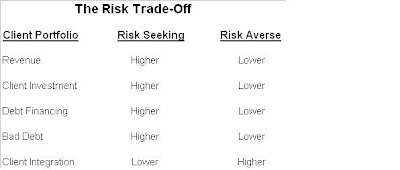
There have been countless books written on understanding your client risk portfolio. My favorite is Financial Risk Analysis, by: Jerry F. Dean, CCE. The text is definitely not for the mathematically faint of heart. Dean expounds on many complex models and their relevancy to specific industries and economic climates. However, for sake of simplicity I will present a simple model using some of the variables found in the Capital Asset Pricing Model (CAPM).
The CAPM attempts to valuate the market risk of an investment. The riskiness of the investment as it relates to the market is designated ß (beta). A ß=1 establishes standard market risk. A ß>1 relates to more risky and ß<1 equates to less risky. This model, as applied to a hypothetical firm demonstrates risk tolerance as it relates to overall market risk.
As there are many economic indicators, I have chosen Gross Domestic Product (GDP) as my standard. I would caution the use of inflation as an indicator because of the current economic climate. Let’s assume that annual GDP is 3.9%. During the firm’s budgetary process it is determined that the firm seeks a 7.5% (excluding write-off or write-down) increase in profits over the previous year. Therefore, the firm’s ß becomes 1.93; the percentage return expected by the firm over GDP. To bring this into reality, if the firm’s increased profits are $375,000 over the prior year and the risk model is ß =1.93, then the firm should feel comfortable with a year end return between -$348,750 (loss) and $375,000 (profit).
Once the firm comes to the point of being comfortable with their potential loss and the range of profit to loss, then the greatest loss amount ($348,750) or X% of billings then becomes the firm’s risk tolerance. We as a firm will lose no more than X% in the coming year. From there, the X% must be allocated over all practice groups in light of billings AND economic climate (keep in mind the credit crunch). At that point, each practice group will have their thresholds set; upper 7.5% increase in billings and not write off more than X%. The final step is to adjust the X% to a per client level to adjust for the inherent risk.
It is at this point, that the goals of the firm can be clearly documented, as the firm should be well aware of their potential costs in achieving their goal.
Wednesday, June 18, 2008
Got Commitment?
The effectiveness in managing an organization rests on the commitment of those in management to always operate in the best interest of the organization, sometimes at the detriment of their own self interest. Within the last few months there as been a considerable amount written about lack of commitment in today’s professional services organization. I, myself, have presented a contribution as to the secrets of growing a professional services practice through committed players. Just yesterday, the Wall Street Journal published an article how a lower Manhattan firm has partners scampering to other firms because 2008 profits will be lower than expected.
Today’s professional practice has partners of various commitment levels to the overall profitability of the firm. Those on the lower end of the spectrum are the ‘bad apples’ to the firm and will pull the firm profitability down. Remember that doom and gloom disseminates much faster than excitement and fanfare. For those not committed to their firm, it is time to go searching for that pot of gold at the end of the rainbow. Firm profitability doesn’t start with the partner next door or the department head, it starts with you! You Ms. Partner must stop being involved in collections and become committed to the firm’s profitability through a strong positive cash flow.
As presented in my last contribution, a collections effort is essentially the remnants after the war has been fought or cleaning after the parade has past. Waiting until the work has been completed and billed will essentially close the doors to strong cash flow. Recall, that the collections process must be based on a policy. The collections policy must be a mirror image of the credit policy. Only then does the firm have a strong footing on which to reap a strong positive cash flow. Therefore the first step for the firm is building a credit policy.
The word ‘policy’ conjures up negative connotations of heavy bureaucracy and inflexibility. However, a well constructed policy provides tremendous value to the firm. The top four contributions a credit policy brings to the firm are: 1. It focuses everyone in the firm that client portfolio management is important and serious, 2. It ensures consistency among practice groups, 3. It establishes a consistent message sent to clients and prospects, 4. It reinforces the value of credit and collections to the firm. In building the credit policy, there are two main issues to be observed, the understanding of the firm’s culture with respect to risk and documenting how the firm will manage this risk as part of their client portfolio. The one main reference guide I would suggest to anyone seeking to build a credit policy is: How to Write a Credit Policy, by Cliff Miller. The publication is put out by the Credit Research Foundation. It is extremely well written and walks the reader through the process of creating a credit policy.
The first step in building the credit policy is to understand the credit department’s mission to the organization. This will establish where they fit in the hierarchy and their importance in the eyes of management and all partners. Keep in mind that the credit department and collections department, ideally, should be separate. The credit department’s mandate should be based on the issuance of credit based on the firm’s risk tolerance; this requires a very analytical skill set. While the collections function is more an assisting and encouraging role that works towards getting bills paid; people centric. Both of these functions are encompassed by the firm’s tolerance for risk. Over the coming contributions, the concept of risk management of the client portfolio will be interspersed with the building of the credit policy so as to provide a uniform progression toward a completed policy.
The first question the firm must answer is: What is the mission of the credit department? How this is answered will ultimately determine the firm’s cash flow. I feel the credit department must operate under the direction of the most senior of management, as this department has a tremendous impact on the firm’s cash flow. The mission statement may turn out to be the precursor the identification of the firm’s tolerance for risk. Keep in mind, that the mission statement may possibly be revised by the end of the credit policy. For once set, the credit policy will be the foundation of future cash flows. Here are some examples to seed thought:
The firm in Expansionary Growth Mode (risk seeking)
“It is our policy to provide credit to all potential applicants, regardless of payment experience. The credit department will attempt to screen out clients who obviously will become bad debts. We will attempt to build relationships with all our clients and effect collections without jeopardizing the client relationship.”
The firm who understands their affinity for risk
“The credit department is responsible for maintaining a high level of quality in the client portfolio in direct alignment with the firm’s risk profile. We will act to provide flexible mechanisms to protect the firm’s substantial investment in the client portfolio, while not negatively affecting client engagements.”
The conservative firm who has a strong market position
“The credit department is responsible for managing the firm’s investment in the client portfolio within the risk levels determined by executive management. It is our responsibility to assume no unwarranted risk. We will advise executive management of clients who become risk situations and will make efforts to limit the firm’s credit exposure in these areas.”
Once the firm has established the mission of the credit department, the foundation will be set. From there the firm will establish its commitment toward firm growth, longevity and cash flow. Firms must start with knowing what they want for the firm now and into the future.
Know thyself
Socrates
Thursday, June 05, 2008
The Cash Flow Vacuum
In the last four weeks there has been an explosion of articles written on practice management issues in today’s law practice. Over this time, they have become increasingly bolder and more hostile. Although I believe it is time to make a change regarding the management of today’s legal practice, initiating change is better accepted when it is a product of educating rather than bayoneting the wounded.
All business entities whether commercial or professional services are interested in managing their cash flow. The management of cash flow, a scare resource, is the entire basis of economic modeling. Organizations, as a whole face both an inward and outward cash flow. No one would argue it is the sum of these cash flows that is of greatest interest to an organization. How organizations manage the incoming and outgoing cash flows determines their long term economic viability. Although the management of these processes is entombed with management culture and market dynamics, they can be refined.
The management of outgoing cash flow is easily for most law firms. For the most part, the organization’s vendors communicate how and when they want to get paid. For the law firm, this dynamic goes unquestioned. In all my years of working with and within law firms, 99% of the time vendor bills get paid on time. Whether it is the preservation of a sterling credit rating or the demonstration of financial worthiness, payments are made based on terms.
In today’s legal practice, however, incoming cash is not as well managed. Anyone working in today’s law firm on the collections side would easily attest that cash receipts are dictated by the client’s attitude; where the firm’s bill fits into the client’s priority structure. The important thing for today’s professional services organization is to make sure their bills are at the top of the client’s payment priority structure!
Today’s professional firms are simply operating in a vacuum in how they manage their profitability. In today’s Law.com article Should Small and Midsize Firms Create Strategic Plans? (http://www.law.com/jsp/law/sfb/lawArticleSFB.jsp?id=1202421933007), consultant John Remsen Jr. concludes “Firms often steer clear of crafting the plans because the process is "hard" work and often raises unpleasant issues”. To that I would add, for the most part attorney’s simply lack the acumen to look at the environment and the firm as an economic ecosystem.
Although most firms really don’t undertake planning, other than isolated rudimentary budgeting, there are those who do plan but very few undertake building a strategic vision. On the collections side, most firms that ‘plan’ how much money they will collect each year. However, what I have found to be the most amazing part of the ‘cash receipts plan’ is that it is made in isolation. It is built in complete isolation of the economy, the inherent risk of their client portfolio, the current inventories, and the culture of the firm. These firms rest their entire existence on, essentially a wish rather than a probable reality. This lack of planning is supported by Remsen with “… attorneys often are more focused on short-term issues rather than the longer-term outlook. They also tend to be autonomous in their thinking, and they don't like risks or change”.
Today’s firm have a multitude of interrelated issues, none of which can be resolved overnight. This is also true for commercial entites;as they too have issues. However, commercial entities tend to have more planning and strategic vision as part of their operations diet. One of the first places firms should start, I feel, is achieving a better management of incoming cash flows. Firm’s have to realize that delinquent client payment isn’t a product of a poor collections policy or staffing. It is almost entirely based on the management of risk and client intake. The management of risk must be covered in the firm’s credit policy. In my two decades of working within and around law firms, I have yet to encounter a firm that has true credit policy. Credit and collections policies are meant to work hand-in-hand to firmly ground the organizations relationship with the client; to establish shared expectations.

It is only from tightly coupling between the credit policy and collections policy that firms can establish the foundation on which to accomplish more than budgeting. Firms can begin to strategize about their future, enhance their competitive advantage to become the leader of their peer group.
Whether you (firms) like it, believe it or not – change is happening in the legal market space. Sadly a few firms are initiating change while the market is forcing change on most. Clients are becoming more disenchanted with the practices of today’s firm and the results are being manifested in depressed cash inflows. Jason Mendelson, a VC and lawyer, had this to say to Law.com in the article VC Slams Attorneys on Salaries, Overlawyering, (http://www.law.com/jsp/article.jsp?id=1202421919452) “I've been working on a thesis for quite some time that the entire business model of law firms is going to have to change, or it's going to get uglier."
The issue of having a solid credit and collections policy is, I feel, jugular to the overall financial management of the organization. In order to help firms to act, now, rather than react, later, the next several postings will focus on establishing credit and collections policies in today’s economy.
Friday, May 30, 2008
Practicing Business or Business Practice?
Over the last few weeks I have been fixated on the concept of change within today’s professional services. As an outsider to the law firm environment, yet with tremendous contact within firms, I sit in awe of the next call or email talking about the firm’s trials and tribulations. It is amazing how an outsider can see, in real-time, what is happening yet those in the very midst are simply unaware of the metamorphosis that is occurring within their firms.
In the past week I had the opportunity to have a round table discussion with corporate CFO’s on the concept of financial management and budgeting. I was amazed that so few corporations build budgets based on current economic trends and are revising their position each quarter. Often these organizations see the budget as the Holy Grail, and any negative divergence creates frustrations and animosity among the ranks. I also hear of this type of behavior in today’s legal practices. Firms create their budgets for the upcoming year in a vacuum, and then etch them in stone. When the firm doesn’t live up to expectations, frustrations and dissension permeate the ranks.
Since my last posting there has been a lot of news articles hitting the press about what is happening with law firms. For the most part, law firms are facing the same economic pressures every other organization is facing. With these pressures some organizations soar while others sink. The reason for which, each firm reacts differently to these economic stimuli. Their response all dependent on when the ‘realize’ the stimulus, their management, their culture and a plethora of other factors.
On May 28, The Wall Street Journal published an article about a Midwest US firm making the decision to trim their ranks by 124 people. (http://blogs.wsj.com/law/2008/05/28/sonnenschein-lays-off-37-lawyers-plus-87-others/). Since the release of the article several firms throughout the
However, one day later an article in legalWeek.com identified a firm whose revenue rose 24% from last year. http://www.legalweek.com/Articles/1130817/Bird++Bird+flies+high+with+24+revenue+rise.html How could that be, here are two firms facing the same economic environment and their response is very different. The answer is definitely not simple and would require a thorough understanding of their practices and their management. On a very simplistic note, change happens and firms have to react to change. How they react is a product of their management and their culture. How they react to stimuli will determine their place on the competitive continuum.
I personally feel that those who change their position on the continuum rest in how they develop a response to a stimulus. A much stayed organization will seek to apply ‘old’ solutions to new problems. As such they will slowly get left behind. It is the progressive firm that steps outside of the status quo, challenging the norm that will leap ahead of others. In a recent webinar by Kevin O’Keefe, (www.lexblog.com), on attorney blogging, O’Keefe made a subtle point of how different firms assimilate attorney blogging. For some firms, it is the taboo because of the social pressures of the other attorneys and the Bar hasn’t made any statement on blogging. While for other firms reap huge benefits. Both firms faced with the opportunity; one stayed and the other innovative.
A great example of a firm not choosing the status quo response was published by LegalWeek.com on May 22. In not knowing the background, one can only speculate the firm had a decline in their litigation practice. When faced with this stimulus, they came up with a ‘cost-free’ litigation program for their clients; which they named CONTROL. http://www.legalweek.com/Articles/1128480/Article.html
Change happens all the time, what happens to your organization rests solely on how you respond to it. You can seek innovative ways or hammer in the ‘tried and true’, the choice is completely yours. Keep in mind, old solutions work for old problems. In difficult times, innovation is the fuel for your organization to gain the competitive advantage. Choosing old solutions is simply business practice. Today, law firms need to be practicing business– treating the practice of law – as a business.
Tuesday, May 20, 2008
Change Happens, Initiate it or React to it!
In 2007, I realized that after spending almost two decades in professional services it was time to speak what those in firms all around the world were thinking. Looking back on my original writings on this form and in publications, although the topics changed; the theme didn’t. The core theme which I have been professing has always been the same – it’s time for change. Break free of the bondage of your ancestry and lead the pack!
In the academic world there are volumes upon volumes of articles that address organizational change. Everything from being a change master to managing the process of change, some of the great business writers lately have been very bold in putting forth their ideas. With all of this going on, there is one thing for sure – change happens. Several years ago a great little book was written Who Moved my Cheese by Dr. Spencer Johnson M.D. The book took a light-hearted approach in explaining the human behavior of failure to change, as demonstrated through mice in a maze. This is definitely a must read for anyone who feels they are no longer growing or changing.
I have found through the years that society is built up of institutions that assume positions along the ‘habit/status quo’ continuum. There are those institutions that constantly push the status quo, with their developing of the latest and greatest. While there are others who are more stayed in their behavior. Those who push the status quo, evolve more, learn more, earn more, and do more for society. Conversely, those who are stayed they experience decreasing membership in their institutions, soon they wither and die. Several years ago a colleague shared with me his experience with a financial institution that found its roots in the 17th century. When he joined the organization their business processes probably dated back to their origins. During his tenure, the board of directors interviewed for a new president. Throughout the interview, the candidate responded to various questions with the same line, ‘I will change things’. Finally the interviewer asked what will you change? To whom he replied, things. The point to be made here, was that a change was needed, any change. The organization had become stagnant over its life and this visionary saw that a single change will be the precipitate to many changes. Today that organization has now in 120 countries around the globe and in many of those countries, has become the leader in the financial markets.
My contribution of last week precipitated several comments. The one that I feel is most relevant to share is from Ed Poll. I have known Ed for a few years and I have always been inspired by his writings. I feel he is the voice of change in the legal management community. Ed’s closing remarks on last week’s contribution was: “Nevertheless, there is much about the operation of law firms that needs to be examined more closely and then changed if the "institution," called a law firm is to survive and thrive.” Ed’s statement comes at a time, I feel, when today’s law firms are at the cusp of a business management change. No longer can firms continue along the antiquated behavior of doing the same things month after month, year after year, decade after decade and not only expecting the same results… but better results!
The cascading changes that law firms will face will probably come by way of one or two very progressive forward thinking organizations. They will be the fuel that fires the change of the legal landscape. In reviewing the literature of today, I feel this impetus to this type of overwhelming change will come from a smaller firm outside of North America. The seed to change will be from a firm not imbued in processes of their history; they will push the status quo and thereby make change. In the last two years, we have seen considerable change in law firms outside of North America. One such firm, an Australian law firm went public. Currently in the Asia Pacific regions, companies are no longer accepting the status quo for legal services and legal fees. Corporations are undertaking statistical and probability analyses to identify their return on investment in legal engagements. It is this type of analysis that will determine if they proceed or halt the engagement.
On May 7 LawFuel, a New Zealand publication, ran an article entitled Are Lawyers getting away with Blue Murder on fees? The author cites that there is a considerable increase in outside consultants who review the legal engagements and assist in getting the costs ‘seriously trimmed’. I feel these two incidents are very important to the future of law firm viability as we see it today. One firm, taking a proactive approach in adopting more business behavior through outsiders objectively examining their business management, while there is a growing malcontent in the market that will push law firms to change. One firm is taking a more proactive, non-status quo approach, while the others are being subjected to increasing pressure to change. Either way change is happening and the institution of the practice of law as we have come to know it; is ripe for change.
No matter what you choose to do, you will be affected by change. Metaphorically, you can lead the pack or get trampled by it. At this point, the choice is yours. However, when market change begins, and it will fast and pervasive, you will be in your defined spot and will have to suffer the consequences. Maybe it is time for firms to empower their business managers to critically examine the firm and make it part of the change and not let it fall victim to being a product of change.
Sunday, May 11, 2008
A MAP got us in this mess, only a GPS will get us out!
Over the last couple of days I had an interesting opportunity; I was asked to comment on a friend’s homework who is working on their MBA. For many this would not be considered an exciting opportunity. However, I saw it as such. Other than my personal research into my own ‘pet projects’, this was an opportunity for me to be academically challenged. After working through the assignment and speaking with other students in the class I realized that a decade has passed since the completion of my MBA. However, what really struck me was the immensity and diversity of business thought currently being presented in the academic world.
As I pondered the experience a statement that I had heard from a Nobel Prize winner a few years ago came to mind. The statement goes something like ‘…there have been more advancements in science, technology and insight in the last century than in all preceding time’. As I thought on this, I could name many of the greats of the last century, but I would be hard pressed to go back much further. The deduction I came away with; knowledge seeds knowledge and to that end, we will continue to see increasingly more ideas presented in our world.
With all of these new ideas it shouldn’t be amazing how the world continues to change so rapidly. These changes are the result of people assimilating new ideas and changing their world one tiny bit and as a whole the effect is commutative; hence more pronounced change. However this isn’t the case with everyone and every organization! There are a plethora of reasons why people simply do not assimilate new ideas. These could be self-imposed or a product of their ‘perception’ of the world; either way the gradation leaders and laggard continues.
A few of my recent readings have challenged me to make sense of why some organizations tend to be leaders and some laggards. I feel this gradient of success is a result of self-imposed limitations or narcissistic traits. Interestingly enough, in my career, I have visited organizations that continue to hold their place along the continuum of success, given the wealth of business knowledge at their fingertips they continue to run as they did a century or more ago.
In a recent article in The Lawyer, one of the London City firms had decided to increase rates by 11%, while other firms have upwardly adjusted their rates by 4%. While at the same time, more peripheral firms have refused to alter their rates while some have shed some associate staff, while on the other side of the globe, in Australia, a new industry is blossoming; that of legal advisory. Australian commercial clients are engaging advisors to determine a fair and reasonable cost for their legal work. The clients then present the findings to firms to see who will accept it for the specified rate. While several large US firms have trimmed staff and stabilized their rates. This radical divergence of behavior at a time of economic contraction is indicative of how people assimilate, the current thought and how others continue in their historical belief.
In my career and travels I have found that in the case of law firms, the non-US law firms are more amenable to change. Even though some continue in their pre-Cambrian ways, they still undertake change; often begrudgingly. In my 2007 contribution Taxation the best Collection Motivator, I addressed why countries who have a Value added Tax system and those governments who impose accrual accounting on professional services firms are much more focused on current asset (WIP and AR) management. In the US firms hide under the veil of cash basis accounting and a much more lenient taxation structure. It is the lack of external forces in the US firms that diminishes the urgency for betterment.
Throughout history professional services was the ‘class’ of the elitist. Those of professional designation could hang their shingle, acquire clients and get financing without any formal business constraints; other than those imposed by their professional association. It is within this self-perpetuating comfort zone that professional services continue, often oblivious to what is going on around them. They operate without a clear vision of where they are going or a clear mission of who they are. This is made clear through the diversity in reactions to an economic softening of the global economy.
Interestingly these are the same organizations that maintain a mantra of higher rates equates to higher profits per partner, when in fact profit is a multi-faceted entity comprised of billable fees, related costs, overhead costs and write offs. It never ceases to amaze me how these ‘head strong’ leaders simply overlook all of these components to profitability. During a conversation, earlier this week, with Ed Poll, author of many works on how to manage legal practices, I was reminded of statement Ed had made quite some time ago “…in many law firms collections is almost an afterthought with as much as 30-40 percent of their billings are collected in the last two months of the fiscal year”. It is surprising with all of the knowledge out there, so many firms continue in their historic practices; the fire fight mentality. While the rest of the world has assimilated the ideas that profit is the culmination of many components and requires a multi-pronged approach for its growth.
This position is the result of, what I perceive, a misaligned accountability process (MAP). Simply put, it is the failure of all of the firm’s partners to be held accountable for their contribution to the firm’s profitability. Since there is no external body like taxation, corporate organization or Sarbanes-Oxley to instill a methodology of accountability the historical practices continue. One would argue that the professional services regulatory body would set guidelines for behavior. However, in my experience this has proven to be ineffective. The article Learning the Hard Way, by Stephanie Ward from the May 2008 issue of the ABA Journal, gives insight as to why some firms continue to act as they have always acted. According to Litigator Michael Burke “Lawyers often think they are smarter than anyone else”, the article continues with many examples of how some lawyers’ self-empowering narcissism has pushed them to the top and caused them to crash and burn. I feel this makes a tremendously powerful statement when one fails to understand why firms resist change.
I feel it is high time that change enter the professional services market. The change that is required must begin at the partner level, first through the deflation of ego followed by the assimilation of ideas into the practice. Firms have to empower their highly educated support group to read market indicators and bring forward new and exciting ideas that will not only catapult the firm forward but begin to erase the negative stigma in the market place. Today’s professional service organizations need a good strategy for survival and growth that comes as a direct result of reading the market indicators, assimilating new ideas and acting in a concerted accountable approach that will yield success. This great practical strategy (GPS) must be the new insightful technology to lead the firm forward, as the MAP has really gotten the firm in a quagmire.
Subscribe to:
Posts (Atom)
