Over the last several weeks all of the pieces to an effective credit policy were formulated. By now, the astute person would have this framework awaiting approval. Policies are essentially useless unless they are put into action to initiate change. The beginning of change comes with the collection policy and related efforts.
The collection policy essentially outlines the systematic steps that must be applied to manage the accounts receivable. Recall that the credit policy established the guidelines on which the organization will manage their client relationships. The collection policy starts the moment accounts receivable is generated in the relationship. If you are following this process closely, the question you should have is, “How is inventory (work in progress) managed?” The management of inventory is defined in the assessment of client risk, as it is the sum of inventory and accounts receivable that designates the investment in the client relationship.
After years of research into the reasons for delinquent accounts receivable, the causes can be reduced to: relationship, billing and/or economic. To the credit/collections professional, these issues can all be resolved. The easiest issue to resolve is that of billing. A simple flow audit through the organization will unearth some of the issues surrounding billing. For a bill to be accepted, it must conform to the terms of the engagement. i.e. meet the terms of the Purchase Order, or engagement letter. The bill must clearly outline what goods and services are being billed for, with identification of the timeframe the bill covers. Most importantly the bill must identify a specific recipient, date, when payment is due and any supporting documentation. One of the faux pas with professional services firms is the use of the caption ‘payable upon receipt’. Turning to Webster for clarification, payable can be defined as, “capable of being or liable to be paid’. Sounds a little illusive, how about “payment due upon receipt”, which removes any ambiguity!
Delinquent receivables are the result of client related economic issues, and this is a tremendous opportunity for the organization to establish client good will as well as solidify a long term relationship. Economic misfortunes may or may not be the result of client actions. It is the astute firm that can use the situation to complete or continue the engagement while ensuring payment is forthcoming. This is where the savvy collection sense of the credit department can leap in to action. In so doing, provide payment options for the client so as to maintain the relationship.
The most difficult issue surrounding delinquent receivables occurs when there is a relationship breakdown. When this occurs, the client has essentially professed their position with their check book by silently stating, “I am not paying you!” At this point, firms have options. They could simply walk away from the receivable, otherwise known as a write off. The firm could turn the account to an outside firm that may litigate and possibly recover some of the amounts. This option brings a significantly reduced payment and the possibility for counter claims. Therefore, the firm must be sure that they did everything according to the original engagement. Can you see why it is so important to get the relationship off the ground correctly? The last option is for the client representative to go back to the client and attempt to rebuild the relationship. Rebuilding the relationship isn’t negotiating a settlement, it is accepting that a relationship has two sides and it took two to break up the relationship.
What ever the cause of the delinquent receivable, it is the task of the credit department to flush it out and get the cash flowing. There has been much written in this area, sadly much of it unprofessional. The best piece of advice in this area is to become familiar with the credit/collections laws in your jurisdiction. In the United States credit/collections falls under the, Fair Debt Collection Practices Act. Keep in mind that there are or could be laws for local jurisdictions based on your type of business. A good layperson’s resource written for the US market is The Credit & Collection Manual (CCM), put out by the Credit Research Foundation. This text packs a tremendous amount of resource information in a small handy text. It is a definite must have for any credit department desk.
Regardless of the cause of the delinquent receivable, the first action is to flush out its root cause. The best way to do this is by way of monthly statements of account. For many organizations the sending of monthly statements is deemed to be a waste of time and postage. However, the recipient of a statement can quickly identify what they owe and discrepancies in the billing; whether they choose to act on it or not. For a publically traded company this information is paramount, as a reconciliation of payables is one of the areas investigated during the annual audit. Sending statements is even more important for law firms’ clients. For clients who require an annual audit, information as to the involvement in a lawsuit is paramount, and a statement from the law firm makes it clear to the auditors.
In addition to the monthly statement, the credit department must make contact with the client. According to the CCM, computer generated form letters provide substantial saving in time and expense while being marginally effective. Keep in mind, in light of an economic or relationship distress a ‘nasty-gram’ letter won’t open a dialogue to getting the issue resolved and receiving payment. The text goes on to say that individually prepared collections letters only give the recipient evidence that someone is monitoring the account, but the results are somewhat the same. Collections letters will only generate payment when the recipient simply hasn’t received the billing or truly wants to pay the account but has simply fallen behind. This means of communication isn’t really aimed at problem resolution, it is simply and audit trail toward litigation.
The best approach to flushing out an issue and begin problem resolution is direct telephone contact. This approach is heavily encapsulated in laws; therefore it is only for those well versed in collections laws. Ed Poll in his book, Collecting Your Fee, refers to this time as dial and smile. When done correctly credit professionals will flush out the root cause of the nonpayment, relationship or economic, and thereby begin to formulate a resolution.
There is no mystery to getting your bills paid; it all comes down to having a plan. The plan begins with understanding your affinity for risk, then building a policy for managing the risk. From there, gauge every client relationship against your risk profile while making sure both sides knows what is expected in the relationship. Do the best job you can to fulfill your obligations and have a procedure for managing those few accounts that become delinquent.
To most organizations, the concept of change seems like hiking Mt. Everest. Firms can continue along doing what they have been doing and expecting the same results – that is insanity. Change takes courage, vision and determination. The fork in the road must not be an obstacle, but the chance for a new beginning – choose a direction and let’s ride!
“Insanity: doing the same thing over and over again and expecting different results.” Albert Einstein
“When you get to a fork in the road, take it!” Yogi Berra
"When you look for excuses not to change...they will be found. It takes courage, determination and fortitude to get off the merry go round." S A Miller
Wednesday, July 30, 2008


Tuesday, July 22, 2008
Want GiGo free Accounts Receivable?
The last few weeks were spent building the foundation of a credit policy. If one were meticulous and honest in working through the steps, you would be close to a policy that now reflects the organization’s affinity for risk and one that would form the basis of a collections policy. Although the organization owns the client receivable and work in progress, certain individuals must accept responsibility to ensure the inventory is maintained according to policy. This final contribution on building a credit policy focuses the client and the inventory custodian; the credit department.
Contrary to what may be said, people show their likes and dislikes by how they spend their money. Essentially, they buy from people they like. If the bond doesn’t exist, a sale, no matter the price, isn’t forthcoming. Ed Poll in, Collecting Your Fee, sums it up very well with: You can judge the quality of a relationship by the way it ends…a client who genuinely respects you and the work you did will pay your bill in a timely manner. For me, that statement says it all, barring extenuating circumstances on the client side. There are two ways to achieve and maintain that respect, in order to facilitate payment by establishing the foundation for a good relationship from the very beginning, the first meeting. Then once the relationship is established, open regular communication is essential for maintaining trust.
It is during the very first meeting that the professional must establish the foundation for the relationship. Here is where information is exchanged, including costs, fees, terms of payments, and terms of engagement which must all be discussed and documented. It is also the time in which the professional must seek information about the prospect. PROSPECT. The person on the other side of the desk is a Prospect until such time as they meet the organization’s criteria of acceptance into “client-hood”. It is for this reason that he professional must obtain a completed credit application during the meeting, as this is the only means by which the organization can assess where the Prospect fits regarding the firm’s affinity for risk. At the end of the meeting, the professional should have explained the nature of the engagement and provide all discussed to the Prospect, either as an engagement letter or proposal; which must be signed and returned. The professional should have a fully completed and signed credit report.
The credit report form provides core insight into the Prospect’s business; their inherent risk. At this point, the firm must quantify the risk and compare it to their affinity for risk. The process by which this is done was discussed earlier in Crystallizing Goals. The part of the organization that is responsible for making this determination is – the credit department. This responsibility must be clearly documented in the credit policy. Depending on the size and complexity of the organization this section may involve a varying degree of detail. By way of example, here are a couple of options that will seed thought:
The credit department establishes credit limits for all prospects and active clients. These limits are based on D&B or TRW ratings, credit references, financial statements, security, or other information obtained directly from the applicants. The credit department must review large client investments on a periodic basis. All limits are subject to revision, based on changing levels of credit worthiness. Only executive management has the authority to override limits established by the credit department. All overrides must be fully documented and the requesting professional is fully responsible for their collection.
Or
Professionals will obtain a completed and signed firm designated credit application from each prospect. This will contain bank reference and three trade references. Through due process, the credit department will determine the prospect’s ability to pay and the level of risk they pose should they become clients. Should the prospect be accepted as a client, a credit limit will be assigned through the use of scoring tools and techniques. Where the professional determines the credit limit is insufficient for the engagement, the prospect must provide 2 years of financial statements or must maintain, on deposit, the equivalent of 1/3 of the expected cost of the engagement. Only executive management can override this policy.
Having a clear delineation of responsibility for the credit department, the professional and the executive officer ensures that the credit policy is adhered to. With the sign off on the entire policy, all people in the organization will act to ensure a consistent approach for dealing with clients. Your AR is a direct reflection of your organization, if it is full of delinquent garbage AR, you put it there through your practices. Only you can stop the build up of garbage AR – build a garbage-free client portfolio!
In closing,
"When you look for excuses not to change...they will be found. It takes courage, determination and fortitude to get off the merry go round"
Organizations are not the victims of their delinquent clients. You and your organization cause your collections problems by not telling your clients from the beginning what you expect from them. Ed Poll
Contrary to what may be said, people show their likes and dislikes by how they spend their money. Essentially, they buy from people they like. If the bond doesn’t exist, a sale, no matter the price, isn’t forthcoming. Ed Poll in, Collecting Your Fee, sums it up very well with: You can judge the quality of a relationship by the way it ends…a client who genuinely respects you and the work you did will pay your bill in a timely manner. For me, that statement says it all, barring extenuating circumstances on the client side. There are two ways to achieve and maintain that respect, in order to facilitate payment by establishing the foundation for a good relationship from the very beginning, the first meeting. Then once the relationship is established, open regular communication is essential for maintaining trust.
It is during the very first meeting that the professional must establish the foundation for the relationship. Here is where information is exchanged, including costs, fees, terms of payments, and terms of engagement which must all be discussed and documented. It is also the time in which the professional must seek information about the prospect. PROSPECT. The person on the other side of the desk is a Prospect until such time as they meet the organization’s criteria of acceptance into “client-hood”. It is for this reason that he professional must obtain a completed credit application during the meeting, as this is the only means by which the organization can assess where the Prospect fits regarding the firm’s affinity for risk. At the end of the meeting, the professional should have explained the nature of the engagement and provide all discussed to the Prospect, either as an engagement letter or proposal; which must be signed and returned. The professional should have a fully completed and signed credit report.
The credit report form provides core insight into the Prospect’s business; their inherent risk. At this point, the firm must quantify the risk and compare it to their affinity for risk. The process by which this is done was discussed earlier in Crystallizing Goals. The part of the organization that is responsible for making this determination is – the credit department. This responsibility must be clearly documented in the credit policy. Depending on the size and complexity of the organization this section may involve a varying degree of detail. By way of example, here are a couple of options that will seed thought:
The credit department establishes credit limits for all prospects and active clients. These limits are based on D&B or TRW ratings, credit references, financial statements, security, or other information obtained directly from the applicants. The credit department must review large client investments on a periodic basis. All limits are subject to revision, based on changing levels of credit worthiness. Only executive management has the authority to override limits established by the credit department. All overrides must be fully documented and the requesting professional is fully responsible for their collection.
Or
Professionals will obtain a completed and signed firm designated credit application from each prospect. This will contain bank reference and three trade references. Through due process, the credit department will determine the prospect’s ability to pay and the level of risk they pose should they become clients. Should the prospect be accepted as a client, a credit limit will be assigned through the use of scoring tools and techniques. Where the professional determines the credit limit is insufficient for the engagement, the prospect must provide 2 years of financial statements or must maintain, on deposit, the equivalent of 1/3 of the expected cost of the engagement. Only executive management can override this policy.
Having a clear delineation of responsibility for the credit department, the professional and the executive officer ensures that the credit policy is adhered to. With the sign off on the entire policy, all people in the organization will act to ensure a consistent approach for dealing with clients. Your AR is a direct reflection of your organization, if it is full of delinquent garbage AR, you put it there through your practices. Only you can stop the build up of garbage AR – build a garbage-free client portfolio!
In closing,
"When you look for excuses not to change...they will be found. It takes courage, determination and fortitude to get off the merry go round"
Organizations are not the victims of their delinquent clients. You and your organization cause your collections problems by not telling your clients from the beginning what you expect from them. Ed Poll
Monday, July 14, 2008
Who’s on First?
To continue with the series of building a credit policy, identifying who is on first is the initial step in beginning to gel the entire policy into a workable procedure. Previously, we outlined the mission of credit within the organization, and then we examined risk and the organization’s affinity to risk. This exercise has set the foundation for what is to follow, integrating the foundation into the structure.
Identifying and empowering the group who will transform the written policy to a way of life within the organization is the most important part of the credit policy. How the responsibility and authority is divided will either produce a highly effective credit department or a serious cost burden on the organization. Senior management, at this point, must clearly define the credit authority and responsibility of the chosen individual or group. Once established, management must uphold the decision of the credit group throughout the entire management infrastructure. If the credit responsibility and authority is not held steadfast by senior management, the credit function will be riddled with squabbling, poor morale, and horrid results.
Ideally, the credit function should report to the most senior of management; treasurer and / or finance committee. At this level of authority, the decision makers have already established the organization’s affinity for risk. Therefore, they must be the body that determines if the organization should accept an engagement for a client which poses a higher than acceptable amount of credit risk. Following are examples of how the credit responsibility section of the credit policy can be worded.
The credit department reports to the office of the treasurer (managing partner); it includes all functions relating to the extension of credit, collections and cash application. The credit manager establishes all credit limits, has final authority to hold or release all engagements when credit problems exist, decides when credit privileges should be revoked and decides when formal credit activity should be initiated.
Recognizing that certain engagements can be beneficial to the organization, the policy could carve out sections that cap credit limits to the credit department and permit management some slack in accepting the engagement. An example for which as follows:
The credit department reports to the office of the treasurer (managing partner). The credit manager may establish credit limits up to $ XX,XXX, and the manager may delegate up to $X,XXX of authority to other credit personnel. Higher limits MUST be approved by the office of the treasurer (managing partner). Those parties requesting higher credit limits than established by the credit department must submit a comprehensive business model as the amount of credit requested, terms of payment and means by which the credit risk is mitigated to firm established limits. In the event an engagement is being withheld because of credit problems, all parties including the office of the treasurer (managing partner), must meet to gain consensus on a solution.
The clarity and authority by which this section of the policy is written will determine the effectiveness of the credit function in the organization. Organizations need to realize that they needn’t accept every engagement. It is interesting to witness the number of organizations that accept engagements from clients who have a higher probability of default than making payment terms. Organizations fail to internalize that doing work for which no payment will be received is known as ‘charity’. As mentioned previously and will be again, the suggestion isn’t to shun these engagements, but rather build a payment arrangement, through retainers, COD etcetera that will allow the organization to accept the engagement through the mitigation of risk to an acceptable level.
There are many tools available to the credit manager and the organization that will allow them to mitigate credit risk while accepting less than sterling engagements. However, the first step is to relinquish any ambiguity of credit responsibility and know definitively ‘who’ is on first!
Identifying and empowering the group who will transform the written policy to a way of life within the organization is the most important part of the credit policy. How the responsibility and authority is divided will either produce a highly effective credit department or a serious cost burden on the organization. Senior management, at this point, must clearly define the credit authority and responsibility of the chosen individual or group. Once established, management must uphold the decision of the credit group throughout the entire management infrastructure. If the credit responsibility and authority is not held steadfast by senior management, the credit function will be riddled with squabbling, poor morale, and horrid results.
Ideally, the credit function should report to the most senior of management; treasurer and / or finance committee. At this level of authority, the decision makers have already established the organization’s affinity for risk. Therefore, they must be the body that determines if the organization should accept an engagement for a client which poses a higher than acceptable amount of credit risk. Following are examples of how the credit responsibility section of the credit policy can be worded.
The credit department reports to the office of the treasurer (managing partner); it includes all functions relating to the extension of credit, collections and cash application. The credit manager establishes all credit limits, has final authority to hold or release all engagements when credit problems exist, decides when credit privileges should be revoked and decides when formal credit activity should be initiated.
Recognizing that certain engagements can be beneficial to the organization, the policy could carve out sections that cap credit limits to the credit department and permit management some slack in accepting the engagement. An example for which as follows:
The credit department reports to the office of the treasurer (managing partner). The credit manager may establish credit limits up to $ XX,XXX, and the manager may delegate up to $X,XXX of authority to other credit personnel. Higher limits MUST be approved by the office of the treasurer (managing partner). Those parties requesting higher credit limits than established by the credit department must submit a comprehensive business model as the amount of credit requested, terms of payment and means by which the credit risk is mitigated to firm established limits. In the event an engagement is being withheld because of credit problems, all parties including the office of the treasurer (managing partner), must meet to gain consensus on a solution.
The clarity and authority by which this section of the policy is written will determine the effectiveness of the credit function in the organization. Organizations need to realize that they needn’t accept every engagement. It is interesting to witness the number of organizations that accept engagements from clients who have a higher probability of default than making payment terms. Organizations fail to internalize that doing work for which no payment will be received is known as ‘charity’. As mentioned previously and will be again, the suggestion isn’t to shun these engagements, but rather build a payment arrangement, through retainers, COD etcetera that will allow the organization to accept the engagement through the mitigation of risk to an acceptable level.
There are many tools available to the credit manager and the organization that will allow them to mitigate credit risk while accepting less than sterling engagements. However, the first step is to relinquish any ambiguity of credit responsibility and know definitively ‘who’ is on first!
Tuesday, July 01, 2008
Crystallizing Goals
Continuing on the theme of building a credit policy, once the firm has a feel of their affinity for risk the next step is to understand the client dynamic. As was presented in the last contribution, clients bring to the firm a certain level of inherent risk. For the most part, the amount of inherent risk is unknown to the firm. However, there are tools in the market that will give insight into the nature of the client. Although your client profile may appear like:
 In reality, each of the above bands hides carries with it the probability of default as given by:
 With the firm’s understanding of its affinity to market and inherent risk, the goals of the credit policy can be established. Miller, in How to Write a Credit Policy, contends that one can establish true numerical goals or more fluid goals, but I believe the true numeric goals bind the organization to a dedicated practice of receivables management.
A true numeric type goal is as follows:
Our goals are to limit bad debts to X% of billings, Days Sales Outstanding to Y days, and receivables agings to no more than Z% beyond 60 days.
Alternatively, the more fluid type goal is as follows:
The credit department strives to meet goals, established by senior management, that relate to bad debts, receivable agings and Days Sales Outstanding.
Although goals change, having a clear numerical definition for the credit department and the firm will establish a clear commitment to the credit team and the entire firm. Once this goal is established, the firm should undertake to build a credit application. The credit application is the first means by which the firm obtains financial insight into the client – the inherent risk. There are a plethora of examples on how to build a credit application. Ed Poll, in Collecting Your Fee, provides a very simplified yet very functional client intake/credit application form. The information to be captured must include, at minimum: Full legal name, address, telephone/fax, type of company, tax id, owner/manager information, SIC number, trade references, Bank References and signature of the prospect/client to accept financial responsibility of invoices. For professional services organizations, this information should be included in the engagement letter. This letter must fully document the type of relationship, firm policies on billings and when payment is due, firm contacts, who will be working on the file, and billable rates.
With this information in hand and concurrent with a conflicts check, the firm should undertake a credit check of the prospect. The credit check will determine if the prospect’s ability to pay is in alignment with the firm’s goals and ultimately the firm’s affinity for risk. The first step in gaining insight into the prospect is by way of a credit report. The credit report is a very powerful tool that will give the firm insight into the prospect. The three key credit reporting agencies in the North American market are: Dun & Bradstreet (D&B®), Experian, and Equifax. Although these companies use different algorithms to arrive at their metrics, the metrics you receive are very close amongst the three companies. Using the Dun & Bradstreet system, the following information will be included.
Paydex Score
The Paydex® score is a unique, dollar-weighted indicator that provides an instant overview of how a prospect has paid bills in the past, and how they are likely to pay bills in the future. This is a very important score when it comes to being approved for credit terms or financing. The Paydex® is a 1-100 dollar weighted numerical score of payment performance, calculated using up to 875 payment experiences from trade references reporting into D&B®. Following is the scale and legend.
 Therefore if the prospect is slow 90 days and the firm’s policy is 60 days, the first red flag should go up. It doesn’t mean that the firm should not take the prospect on as a client, but rather alter the terms of engagement understanding the client’s past behavior. This may include a larger retainer than normal or more frequent billing with the stipulation that all invoices are due immediately.
In addition to the Paydex information, all credit reporting agencies will provide information on the prospect's collections history, financial statements and if it has ever suffered any liens or judgments. This information will provide the firm a good understanding of how they should anticipate the client behaving when faced with the firm’s billings. One of the pieces of information that most corporate environments find most helpful is the overall rating. This information essentially ties together all of the information provided by the prospect into an overall rating. The overall D&B rating is as follows:

In reality, each of the above bands hides carries with it the probability of default as given by: With the firm’s understanding of its affinity to market and inherent risk, the goals of the credit policy can be established. Miller, in How to Write a Credit Policy, contends that one can establish true numerical goals or more fluid goals, but I believe the true numeric goals bind the organization to a dedicated practice of receivables management.A true numeric type goal is as follows:
Our goals are to limit bad debts to X% of billings, Days Sales Outstanding to Y days, and receivables agings to no more than Z% beyond 60 days.
Alternatively, the more fluid type goal is as follows:
The credit department strives to meet goals, established by senior management, that relate to bad debts, receivable agings and Days Sales Outstanding.
Although goals change, having a clear numerical definition for the credit department and the firm will establish a clear commitment to the credit team and the entire firm. Once this goal is established, the firm should undertake to build a credit application. The credit application is the first means by which the firm obtains financial insight into the client – the inherent risk. There are a plethora of examples on how to build a credit application. Ed Poll, in Collecting Your Fee, provides a very simplified yet very functional client intake/credit application form. The information to be captured must include, at minimum: Full legal name, address, telephone/fax, type of company, tax id, owner/manager information, SIC number, trade references, Bank References and signature of the prospect/client to accept financial responsibility of invoices. For professional services organizations, this information should be included in the engagement letter. This letter must fully document the type of relationship, firm policies on billings and when payment is due, firm contacts, who will be working on the file, and billable rates.
With this information in hand and concurrent with a conflicts check, the firm should undertake a credit check of the prospect. The credit check will determine if the prospect’s ability to pay is in alignment with the firm’s goals and ultimately the firm’s affinity for risk. The first step in gaining insight into the prospect is by way of a credit report. The credit report is a very powerful tool that will give the firm insight into the prospect. The three key credit reporting agencies in the North American market are: Dun & Bradstreet (D&B®), Experian, and Equifax. Although these companies use different algorithms to arrive at their metrics, the metrics you receive are very close amongst the three companies. Using the Dun & Bradstreet system, the following information will be included.
Paydex Score
The Paydex® score is a unique, dollar-weighted indicator that provides an instant overview of how a prospect has paid bills in the past, and how they are likely to pay bills in the future. This is a very important score when it comes to being approved for credit terms or financing. The Paydex® is a 1-100 dollar weighted numerical score of payment performance, calculated using up to 875 payment experiences from trade references reporting into D&B®. Following is the scale and legend.
Therefore if the prospect is slow 90 days and the firm’s policy is 60 days, the first red flag should go up. It doesn’t mean that the firm should not take the prospect on as a client, but rather alter the terms of engagement understanding the client’s past behavior. This may include a larger retainer than normal or more frequent billing with the stipulation that all invoices are due immediately.In addition to the Paydex information, all credit reporting agencies will provide information on the prospect's collections history, financial statements and if it has ever suffered any liens or judgments. This information will provide the firm a good understanding of how they should anticipate the client behaving when faced with the firm’s billings. One of the pieces of information that most corporate environments find most helpful is the overall rating. This information essentially ties together all of the information provided by the prospect into an overall rating. The overall D&B rating is as follows:
If Dun & Bradstreet has current financials on the prospect, a rating anywhere from 5A to HH will be provided. The 5A to HH ratings reflect the prospect’s size based on Net Worth or equity. If the prospect has supplied financials that show it has a negative Net Worth then the company will not be rated, but will have a – where a rating should be. The second half of Dun & Bradstreet’s rating on the prospect is D&B®’s Composite Credit Appraisal. This is a number from 1 to 4 and follows the 5A to HH rating. The Composite Credit Appraisal reflects D&B®’s overall assessment of the prospect’s creditworthiness. This assessment is based on the financial statements supplied (using financial ratios) in the report and payment history. A 1 is the highest credit assessment you can receive and a 4 is the lowest.
With the crystallizing of the terms of engagement, a result of the firm’s affinity for risk, and some due diligence, firms can essentially mitigate their collection woes and will have the cash flow they expect. With simple tools and structure, firms can mange their cash flows, instead of the clients managing it for them!
With the crystallizing of the terms of engagement, a result of the firm’s affinity for risk, and some due diligence, firms can essentially mitigate their collection woes and will have the cash flow they expect. With simple tools and structure, firms can mange their cash flows, instead of the clients managing it for them!
Thursday, June 26, 2008
Cost of Goals
Continuing from last week’s contribution on building a credit policy, we continue further down the road of building the core foundation. Once the organization has established the mission of the credit department, the next step is to get a grasp on the goals of the credit department. The goals will define the end result of what is to be achieved. For many, this is seen as probably the easiest part of putting together the policy reflecting the belief, “I want to collect this amount of billings and it must happen.” However, this mindset is seriously flawed. This is a product of an isolationist mentality, basically I can want anything, but doesn’t mean I will get it. Sadly many firms begin the year with the ‘want’ and get something seriously different.
The gap established between ‘want’ and ‘received’ is a product of external forces. The components of collecting receivables are a product of internal and external forces of the organization. They are a product of everything from culture to global economics. The first step in bridging the gap is to “know thyself,” and this is much more complex than it appears. For “thyself “is a compilation of organizational culture, as well as local, regional, national and international economics and most importantly the organization’s tolerance for risk.
One’s goal for the credit policy is to have a strong understanding of the organization’s affinity for risk; that chance of loss. The risk each firm faces can be broken down into inherent and market risk. Every client in the firm’s portfolio brings inherent risk and market risk. Market risk is very easily understood; simply look at the US credit crisis (now moving through Europe). It is the probability of default as a result of the impact of the economy. However, inherent risk drives deeper; it is the cultural make up the client, most specifically the management and culture of the client. Take for instance the airline industry, all air carriers are faced with ‘market risk’. However, how are some able to maintain profitability while others can’t – culture. Those profitable airlines have a management team and culture that mitigates their inherent risk to the market place, in light of the market condition. Inherent risk is the risk that each client brings to the market by virtue of their management culture. Thus the firm’s responsibility now rests on how much ‘risk’ (market and inherent) it is willing to bear. Essentially, how much is the firm willing to lose in taking on the engagement that is the ultimate question?
The firm’s first step is to establish how much risk it can tolerate. In simpler terms, how much is it willing to write off for the sake of getting the business? By way of a couple of examples I would like to share two firms I know personally.
The risk seeking firm is located in Los Angeles and their business is based almost exclusively on defending uninsured doctors in medical malpractice suits. According to the CFO, this is a highly lucrative business line. However, the risk of default is HIGH.
Conversely, a Washington, DC firm focuses exclusively on public relations law for the Federal Government. This practice is considerably not as lucrative; however the risk of default is LOW.
Your organizational affinity for risk is essentially a trade off of probability of loss and probability of gain. The following chart pays respect to the gains and costs related to one’s affinity for risk.
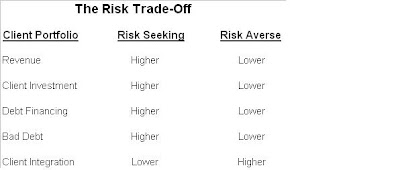
There have been countless books written on understanding your client risk portfolio. My favorite is Financial Risk Analysis, by: Jerry F. Dean, CCE. The text is definitely not for the mathematically faint of heart. Dean expounds on many complex models and their relevancy to specific industries and economic climates. However, for sake of simplicity I will present a simple model using some of the variables found in the Capital Asset Pricing Model (CAPM).
The CAPM attempts to valuate the market risk of an investment. The riskiness of the investment as it relates to the market is designated ß (beta). A ß=1 establishes standard market risk. A ß>1 relates to more risky and ß<1 equates to less risky. This model, as applied to a hypothetical firm demonstrates risk tolerance as it relates to overall market risk.
As there are many economic indicators, I have chosen Gross Domestic Product (GDP) as my standard. I would caution the use of inflation as an indicator because of the current economic climate. Let’s assume that annual GDP is 3.9%. During the firm’s budgetary process it is determined that the firm seeks a 7.5% (excluding write-off or write-down) increase in profits over the previous year. Therefore, the firm’s ß becomes 1.93; the percentage return expected by the firm over GDP. To bring this into reality, if the firm’s increased profits are $375,000 over the prior year and the risk model is ß =1.93, then the firm should feel comfortable with a year end return between -$348,750 (loss) and $375,000 (profit).
Once the firm comes to the point of being comfortable with their potential loss and the range of profit to loss, then the greatest loss amount ($348,750) or X% of billings then becomes the firm’s risk tolerance. We as a firm will lose no more than X% in the coming year. From there, the X% must be allocated over all practice groups in light of billings AND economic climate (keep in mind the credit crunch). At that point, each practice group will have their thresholds set; upper 7.5% increase in billings and not write off more than X%. The final step is to adjust the X% to a per client level to adjust for the inherent risk.
It is at this point, that the goals of the firm can be clearly documented, as the firm should be well aware of their potential costs in achieving their goal.
Wednesday, June 18, 2008
Got Commitment?
The effectiveness in managing an organization rests on the commitment of those in management to always operate in the best interest of the organization, sometimes at the detriment of their own self interest. Within the last few months there as been a considerable amount written about lack of commitment in today’s professional services organization. I, myself, have presented a contribution as to the secrets of growing a professional services practice through committed players. Just yesterday, the Wall Street Journal published an article how a lower Manhattan firm has partners scampering to other firms because 2008 profits will be lower than expected.
Today’s professional practice has partners of various commitment levels to the overall profitability of the firm. Those on the lower end of the spectrum are the ‘bad apples’ to the firm and will pull the firm profitability down. Remember that doom and gloom disseminates much faster than excitement and fanfare. For those not committed to their firm, it is time to go searching for that pot of gold at the end of the rainbow. Firm profitability doesn’t start with the partner next door or the department head, it starts with you! You Ms. Partner must stop being involved in collections and become committed to the firm’s profitability through a strong positive cash flow.
As presented in my last contribution, a collections effort is essentially the remnants after the war has been fought or cleaning after the parade has past. Waiting until the work has been completed and billed will essentially close the doors to strong cash flow. Recall, that the collections process must be based on a policy. The collections policy must be a mirror image of the credit policy. Only then does the firm have a strong footing on which to reap a strong positive cash flow. Therefore the first step for the firm is building a credit policy.
The word ‘policy’ conjures up negative connotations of heavy bureaucracy and inflexibility. However, a well constructed policy provides tremendous value to the firm. The top four contributions a credit policy brings to the firm are: 1. It focuses everyone in the firm that client portfolio management is important and serious, 2. It ensures consistency among practice groups, 3. It establishes a consistent message sent to clients and prospects, 4. It reinforces the value of credit and collections to the firm. In building the credit policy, there are two main issues to be observed, the understanding of the firm’s culture with respect to risk and documenting how the firm will manage this risk as part of their client portfolio. The one main reference guide I would suggest to anyone seeking to build a credit policy is: How to Write a Credit Policy, by Cliff Miller. The publication is put out by the Credit Research Foundation. It is extremely well written and walks the reader through the process of creating a credit policy.
The first step in building the credit policy is to understand the credit department’s mission to the organization. This will establish where they fit in the hierarchy and their importance in the eyes of management and all partners. Keep in mind that the credit department and collections department, ideally, should be separate. The credit department’s mandate should be based on the issuance of credit based on the firm’s risk tolerance; this requires a very analytical skill set. While the collections function is more an assisting and encouraging role that works towards getting bills paid; people centric. Both of these functions are encompassed by the firm’s tolerance for risk. Over the coming contributions, the concept of risk management of the client portfolio will be interspersed with the building of the credit policy so as to provide a uniform progression toward a completed policy.
The first question the firm must answer is: What is the mission of the credit department? How this is answered will ultimately determine the firm’s cash flow. I feel the credit department must operate under the direction of the most senior of management, as this department has a tremendous impact on the firm’s cash flow. The mission statement may turn out to be the precursor the identification of the firm’s tolerance for risk. Keep in mind, that the mission statement may possibly be revised by the end of the credit policy. For once set, the credit policy will be the foundation of future cash flows. Here are some examples to seed thought:
The firm in Expansionary Growth Mode (risk seeking)
“It is our policy to provide credit to all potential applicants, regardless of payment experience. The credit department will attempt to screen out clients who obviously will become bad debts. We will attempt to build relationships with all our clients and effect collections without jeopardizing the client relationship.”
The firm who understands their affinity for risk
“The credit department is responsible for maintaining a high level of quality in the client portfolio in direct alignment with the firm’s risk profile. We will act to provide flexible mechanisms to protect the firm’s substantial investment in the client portfolio, while not negatively affecting client engagements.”
The conservative firm who has a strong market position
“The credit department is responsible for managing the firm’s investment in the client portfolio within the risk levels determined by executive management. It is our responsibility to assume no unwarranted risk. We will advise executive management of clients who become risk situations and will make efforts to limit the firm’s credit exposure in these areas.”
Once the firm has established the mission of the credit department, the foundation will be set. From there the firm will establish its commitment toward firm growth, longevity and cash flow. Firms must start with knowing what they want for the firm now and into the future.
Know thyself
Socrates
Today’s professional practice has partners of various commitment levels to the overall profitability of the firm. Those on the lower end of the spectrum are the ‘bad apples’ to the firm and will pull the firm profitability down. Remember that doom and gloom disseminates much faster than excitement and fanfare. For those not committed to their firm, it is time to go searching for that pot of gold at the end of the rainbow. Firm profitability doesn’t start with the partner next door or the department head, it starts with you! You Ms. Partner must stop being involved in collections and become committed to the firm’s profitability through a strong positive cash flow.
As presented in my last contribution, a collections effort is essentially the remnants after the war has been fought or cleaning after the parade has past. Waiting until the work has been completed and billed will essentially close the doors to strong cash flow. Recall, that the collections process must be based on a policy. The collections policy must be a mirror image of the credit policy. Only then does the firm have a strong footing on which to reap a strong positive cash flow. Therefore the first step for the firm is building a credit policy.
The word ‘policy’ conjures up negative connotations of heavy bureaucracy and inflexibility. However, a well constructed policy provides tremendous value to the firm. The top four contributions a credit policy brings to the firm are: 1. It focuses everyone in the firm that client portfolio management is important and serious, 2. It ensures consistency among practice groups, 3. It establishes a consistent message sent to clients and prospects, 4. It reinforces the value of credit and collections to the firm. In building the credit policy, there are two main issues to be observed, the understanding of the firm’s culture with respect to risk and documenting how the firm will manage this risk as part of their client portfolio. The one main reference guide I would suggest to anyone seeking to build a credit policy is: How to Write a Credit Policy, by Cliff Miller. The publication is put out by the Credit Research Foundation. It is extremely well written and walks the reader through the process of creating a credit policy.
The first step in building the credit policy is to understand the credit department’s mission to the organization. This will establish where they fit in the hierarchy and their importance in the eyes of management and all partners. Keep in mind that the credit department and collections department, ideally, should be separate. The credit department’s mandate should be based on the issuance of credit based on the firm’s risk tolerance; this requires a very analytical skill set. While the collections function is more an assisting and encouraging role that works towards getting bills paid; people centric. Both of these functions are encompassed by the firm’s tolerance for risk. Over the coming contributions, the concept of risk management of the client portfolio will be interspersed with the building of the credit policy so as to provide a uniform progression toward a completed policy.
The first question the firm must answer is: What is the mission of the credit department? How this is answered will ultimately determine the firm’s cash flow. I feel the credit department must operate under the direction of the most senior of management, as this department has a tremendous impact on the firm’s cash flow. The mission statement may turn out to be the precursor the identification of the firm’s tolerance for risk. Keep in mind, that the mission statement may possibly be revised by the end of the credit policy. For once set, the credit policy will be the foundation of future cash flows. Here are some examples to seed thought:
The firm in Expansionary Growth Mode (risk seeking)
“It is our policy to provide credit to all potential applicants, regardless of payment experience. The credit department will attempt to screen out clients who obviously will become bad debts. We will attempt to build relationships with all our clients and effect collections without jeopardizing the client relationship.”
The firm who understands their affinity for risk
“The credit department is responsible for maintaining a high level of quality in the client portfolio in direct alignment with the firm’s risk profile. We will act to provide flexible mechanisms to protect the firm’s substantial investment in the client portfolio, while not negatively affecting client engagements.”
The conservative firm who has a strong market position
“The credit department is responsible for managing the firm’s investment in the client portfolio within the risk levels determined by executive management. It is our responsibility to assume no unwarranted risk. We will advise executive management of clients who become risk situations and will make efforts to limit the firm’s credit exposure in these areas.”
Once the firm has established the mission of the credit department, the foundation will be set. From there the firm will establish its commitment toward firm growth, longevity and cash flow. Firms must start with knowing what they want for the firm now and into the future.
Know thyself
Socrates
Thursday, June 05, 2008
The Cash Flow Vacuum
In the last four weeks there has been an explosion of articles written on practice management issues in today’s law practice. Over this time, they have become increasingly bolder and more hostile. Although I believe it is time to make a change regarding the management of today’s legal practice, initiating change is better accepted when it is a product of educating rather than bayoneting the wounded.
All business entities whether commercial or professional services are interested in managing their cash flow. The management of cash flow, a scare resource, is the entire basis of economic modeling. Organizations, as a whole face both an inward and outward cash flow. No one would argue it is the sum of these cash flows that is of greatest interest to an organization. How organizations manage the incoming and outgoing cash flows determines their long term economic viability. Although the management of these processes is entombed with management culture and market dynamics, they can be refined.
The management of outgoing cash flow is easily for most law firms. For the most part, the organization’s vendors communicate how and when they want to get paid. For the law firm, this dynamic goes unquestioned. In all my years of working with and within law firms, 99% of the time vendor bills get paid on time. Whether it is the preservation of a sterling credit rating or the demonstration of financial worthiness, payments are made based on terms.
In today’s legal practice, however, incoming cash is not as well managed. Anyone working in today’s law firm on the collections side would easily attest that cash receipts are dictated by the client’s attitude; where the firm’s bill fits into the client’s priority structure. The important thing for today’s professional services organization is to make sure their bills are at the top of the client’s payment priority structure!
Today’s professional firms are simply operating in a vacuum in how they manage their profitability. In today’s Law.com article Should Small and Midsize Firms Create Strategic Plans? (http://www.law.com/jsp/law/sfb/lawArticleSFB.jsp?id=1202421933007), consultant John Remsen Jr. concludes “Firms often steer clear of crafting the plans because the process is "hard" work and often raises unpleasant issues”. To that I would add, for the most part attorney’s simply lack the acumen to look at the environment and the firm as an economic ecosystem.
Although most firms really don’t undertake planning, other than isolated rudimentary budgeting, there are those who do plan but very few undertake building a strategic vision. On the collections side, most firms that ‘plan’ how much money they will collect each year. However, what I have found to be the most amazing part of the ‘cash receipts plan’ is that it is made in isolation. It is built in complete isolation of the economy, the inherent risk of their client portfolio, the current inventories, and the culture of the firm. These firms rest their entire existence on, essentially a wish rather than a probable reality. This lack of planning is supported by Remsen with “… attorneys often are more focused on short-term issues rather than the longer-term outlook. They also tend to be autonomous in their thinking, and they don't like risks or change”.
Today’s firm have a multitude of interrelated issues, none of which can be resolved overnight. This is also true for commercial entites;as they too have issues. However, commercial entities tend to have more planning and strategic vision as part of their operations diet. One of the first places firms should start, I feel, is achieving a better management of incoming cash flows. Firm’s have to realize that delinquent client payment isn’t a product of a poor collections policy or staffing. It is almost entirely based on the management of risk and client intake. The management of risk must be covered in the firm’s credit policy. In my two decades of working within and around law firms, I have yet to encounter a firm that has true credit policy. Credit and collections policies are meant to work hand-in-hand to firmly ground the organizations relationship with the client; to establish shared expectations.

It is only from tightly coupling between the credit policy and collections policy that firms can establish the foundation on which to accomplish more than budgeting. Firms can begin to strategize about their future, enhance their competitive advantage to become the leader of their peer group.
Whether you (firms) like it, believe it or not – change is happening in the legal market space. Sadly a few firms are initiating change while the market is forcing change on most. Clients are becoming more disenchanted with the practices of today’s firm and the results are being manifested in depressed cash inflows. Jason Mendelson, a VC and lawyer, had this to say to Law.com in the article VC Slams Attorneys on Salaries, Overlawyering, (http://www.law.com/jsp/article.jsp?id=1202421919452) “I've been working on a thesis for quite some time that the entire business model of law firms is going to have to change, or it's going to get uglier."
The issue of having a solid credit and collections policy is, I feel, jugular to the overall financial management of the organization. In order to help firms to act, now, rather than react, later, the next several postings will focus on establishing credit and collections policies in today’s economy.
Friday, May 30, 2008
Practicing Business or Business Practice?
Over the last few weeks I have been fixated on the concept of change within today’s professional services. As an outsider to the law firm environment, yet with tremendous contact within firms, I sit in awe of the next call or email talking about the firm’s trials and tribulations. It is amazing how an outsider can see, in real-time, what is happening yet those in the very midst are simply unaware of the metamorphosis that is occurring within their firms.
In the past week I had the opportunity to have a round table discussion with corporate CFO’s on the concept of financial management and budgeting. I was amazed that so few corporations build budgets based on current economic trends and are revising their position each quarter. Often these organizations see the budget as the Holy Grail, and any negative divergence creates frustrations and animosity among the ranks. I also hear of this type of behavior in today’s legal practices. Firms create their budgets for the upcoming year in a vacuum, and then etch them in stone. When the firm doesn’t live up to expectations, frustrations and dissension permeate the ranks.
Since my last posting there has been a lot of news articles hitting the press about what is happening with law firms. For the most part, law firms are facing the same economic pressures every other organization is facing. With these pressures some organizations soar while others sink. The reason for which, each firm reacts differently to these economic stimuli. Their response all dependent on when the ‘realize’ the stimulus, their management, their culture and a plethora of other factors.
On May 28, The Wall Street Journal published an article about a Midwest US firm making the decision to trim their ranks by 124 people. (http://blogs.wsj.com/law/2008/05/28/sonnenschein-lays-off-37-lawyers-plus-87-others/). Since the release of the article several firms throughout the
However, one day later an article in legalWeek.com identified a firm whose revenue rose 24% from last year. http://www.legalweek.com/Articles/1130817/Bird++Bird+flies+high+with+24+revenue+rise.html How could that be, here are two firms facing the same economic environment and their response is very different. The answer is definitely not simple and would require a thorough understanding of their practices and their management. On a very simplistic note, change happens and firms have to react to change. How they react is a product of their management and their culture. How they react to stimuli will determine their place on the competitive continuum.
I personally feel that those who change their position on the continuum rest in how they develop a response to a stimulus. A much stayed organization will seek to apply ‘old’ solutions to new problems. As such they will slowly get left behind. It is the progressive firm that steps outside of the status quo, challenging the norm that will leap ahead of others. In a recent webinar by Kevin O’Keefe, (www.lexblog.com), on attorney blogging, O’Keefe made a subtle point of how different firms assimilate attorney blogging. For some firms, it is the taboo because of the social pressures of the other attorneys and the Bar hasn’t made any statement on blogging. While for other firms reap huge benefits. Both firms faced with the opportunity; one stayed and the other innovative.
A great example of a firm not choosing the status quo response was published by LegalWeek.com on May 22. In not knowing the background, one can only speculate the firm had a decline in their litigation practice. When faced with this stimulus, they came up with a ‘cost-free’ litigation program for their clients; which they named CONTROL. http://www.legalweek.com/Articles/1128480/Article.html
Change happens all the time, what happens to your organization rests solely on how you respond to it. You can seek innovative ways or hammer in the ‘tried and true’, the choice is completely yours. Keep in mind, old solutions work for old problems. In difficult times, innovation is the fuel for your organization to gain the competitive advantage. Choosing old solutions is simply business practice. Today, law firms need to be practicing business– treating the practice of law – as a business.
Tuesday, May 20, 2008
Change Happens, Initiate it or React to it!
In 2007, I realized that after spending almost two decades in professional services it was time to speak what those in firms all around the world were thinking. Looking back on my original writings on this form and in publications, although the topics changed; the theme didn’t. The core theme which I have been professing has always been the same – it’s time for change. Break free of the bondage of your ancestry and lead the pack!
In the academic world there are volumes upon volumes of articles that address organizational change. Everything from being a change master to managing the process of change, some of the great business writers lately have been very bold in putting forth their ideas. With all of this going on, there is one thing for sure – change happens. Several years ago a great little book was written Who Moved my Cheese by Dr. Spencer Johnson M.D. The book took a light-hearted approach in explaining the human behavior of failure to change, as demonstrated through mice in a maze. This is definitely a must read for anyone who feels they are no longer growing or changing.
I have found through the years that society is built up of institutions that assume positions along the ‘habit/status quo’ continuum. There are those institutions that constantly push the status quo, with their developing of the latest and greatest. While there are others who are more stayed in their behavior. Those who push the status quo, evolve more, learn more, earn more, and do more for society. Conversely, those who are stayed they experience decreasing membership in their institutions, soon they wither and die. Several years ago a colleague shared with me his experience with a financial institution that found its roots in the 17th century. When he joined the organization their business processes probably dated back to their origins. During his tenure, the board of directors interviewed for a new president. Throughout the interview, the candidate responded to various questions with the same line, ‘I will change things’. Finally the interviewer asked what will you change? To whom he replied, things. The point to be made here, was that a change was needed, any change. The organization had become stagnant over its life and this visionary saw that a single change will be the precipitate to many changes. Today that organization has now in 120 countries around the globe and in many of those countries, has become the leader in the financial markets.
My contribution of last week precipitated several comments. The one that I feel is most relevant to share is from Ed Poll. I have known Ed for a few years and I have always been inspired by his writings. I feel he is the voice of change in the legal management community. Ed’s closing remarks on last week’s contribution was: “Nevertheless, there is much about the operation of law firms that needs to be examined more closely and then changed if the "institution," called a law firm is to survive and thrive.” Ed’s statement comes at a time, I feel, when today’s law firms are at the cusp of a business management change. No longer can firms continue along the antiquated behavior of doing the same things month after month, year after year, decade after decade and not only expecting the same results… but better results!
The cascading changes that law firms will face will probably come by way of one or two very progressive forward thinking organizations. They will be the fuel that fires the change of the legal landscape. In reviewing the literature of today, I feel this impetus to this type of overwhelming change will come from a smaller firm outside of North America. The seed to change will be from a firm not imbued in processes of their history; they will push the status quo and thereby make change. In the last two years, we have seen considerable change in law firms outside of North America. One such firm, an Australian law firm went public. Currently in the Asia Pacific regions, companies are no longer accepting the status quo for legal services and legal fees. Corporations are undertaking statistical and probability analyses to identify their return on investment in legal engagements. It is this type of analysis that will determine if they proceed or halt the engagement.
On May 7 LawFuel, a New Zealand publication, ran an article entitled Are Lawyers getting away with Blue Murder on fees? The author cites that there is a considerable increase in outside consultants who review the legal engagements and assist in getting the costs ‘seriously trimmed’. I feel these two incidents are very important to the future of law firm viability as we see it today. One firm, taking a proactive approach in adopting more business behavior through outsiders objectively examining their business management, while there is a growing malcontent in the market that will push law firms to change. One firm is taking a more proactive, non-status quo approach, while the others are being subjected to increasing pressure to change. Either way change is happening and the institution of the practice of law as we have come to know it; is ripe for change.
No matter what you choose to do, you will be affected by change. Metaphorically, you can lead the pack or get trampled by it. At this point, the choice is yours. However, when market change begins, and it will fast and pervasive, you will be in your defined spot and will have to suffer the consequences. Maybe it is time for firms to empower their business managers to critically examine the firm and make it part of the change and not let it fall victim to being a product of change.
In the academic world there are volumes upon volumes of articles that address organizational change. Everything from being a change master to managing the process of change, some of the great business writers lately have been very bold in putting forth their ideas. With all of this going on, there is one thing for sure – change happens. Several years ago a great little book was written Who Moved my Cheese by Dr. Spencer Johnson M.D. The book took a light-hearted approach in explaining the human behavior of failure to change, as demonstrated through mice in a maze. This is definitely a must read for anyone who feels they are no longer growing or changing.
I have found through the years that society is built up of institutions that assume positions along the ‘habit/status quo’ continuum. There are those institutions that constantly push the status quo, with their developing of the latest and greatest. While there are others who are more stayed in their behavior. Those who push the status quo, evolve more, learn more, earn more, and do more for society. Conversely, those who are stayed they experience decreasing membership in their institutions, soon they wither and die. Several years ago a colleague shared with me his experience with a financial institution that found its roots in the 17th century. When he joined the organization their business processes probably dated back to their origins. During his tenure, the board of directors interviewed for a new president. Throughout the interview, the candidate responded to various questions with the same line, ‘I will change things’. Finally the interviewer asked what will you change? To whom he replied, things. The point to be made here, was that a change was needed, any change. The organization had become stagnant over its life and this visionary saw that a single change will be the precipitate to many changes. Today that organization has now in 120 countries around the globe and in many of those countries, has become the leader in the financial markets.
My contribution of last week precipitated several comments. The one that I feel is most relevant to share is from Ed Poll. I have known Ed for a few years and I have always been inspired by his writings. I feel he is the voice of change in the legal management community. Ed’s closing remarks on last week’s contribution was: “Nevertheless, there is much about the operation of law firms that needs to be examined more closely and then changed if the "institution," called a law firm is to survive and thrive.” Ed’s statement comes at a time, I feel, when today’s law firms are at the cusp of a business management change. No longer can firms continue along the antiquated behavior of doing the same things month after month, year after year, decade after decade and not only expecting the same results… but better results!
The cascading changes that law firms will face will probably come by way of one or two very progressive forward thinking organizations. They will be the fuel that fires the change of the legal landscape. In reviewing the literature of today, I feel this impetus to this type of overwhelming change will come from a smaller firm outside of North America. The seed to change will be from a firm not imbued in processes of their history; they will push the status quo and thereby make change. In the last two years, we have seen considerable change in law firms outside of North America. One such firm, an Australian law firm went public. Currently in the Asia Pacific regions, companies are no longer accepting the status quo for legal services and legal fees. Corporations are undertaking statistical and probability analyses to identify their return on investment in legal engagements. It is this type of analysis that will determine if they proceed or halt the engagement.
On May 7 LawFuel, a New Zealand publication, ran an article entitled Are Lawyers getting away with Blue Murder on fees? The author cites that there is a considerable increase in outside consultants who review the legal engagements and assist in getting the costs ‘seriously trimmed’. I feel these two incidents are very important to the future of law firm viability as we see it today. One firm, taking a proactive approach in adopting more business behavior through outsiders objectively examining their business management, while there is a growing malcontent in the market that will push law firms to change. One firm is taking a more proactive, non-status quo approach, while the others are being subjected to increasing pressure to change. Either way change is happening and the institution of the practice of law as we have come to know it; is ripe for change.
No matter what you choose to do, you will be affected by change. Metaphorically, you can lead the pack or get trampled by it. At this point, the choice is yours. However, when market change begins, and it will fast and pervasive, you will be in your defined spot and will have to suffer the consequences. Maybe it is time for firms to empower their business managers to critically examine the firm and make it part of the change and not let it fall victim to being a product of change.
Sunday, May 11, 2008
A MAP got us in this mess, only a GPS will get us out!
Over the last couple of days I had an interesting opportunity; I was asked to comment on a friend’s homework who is working on their MBA. For many this would not be considered an exciting opportunity. However, I saw it as such. Other than my personal research into my own ‘pet projects’, this was an opportunity for me to be academically challenged. After working through the assignment and speaking with other students in the class I realized that a decade has passed since the completion of my MBA. However, what really struck me was the immensity and diversity of business thought currently being presented in the academic world.
As I pondered the experience a statement that I had heard from a Nobel Prize winner a few years ago came to mind. The statement goes something like ‘…there have been more advancements in science, technology and insight in the last century than in all preceding time’. As I thought on this, I could name many of the greats of the last century, but I would be hard pressed to go back much further. The deduction I came away with; knowledge seeds knowledge and to that end, we will continue to see increasingly more ideas presented in our world.
With all of these new ideas it shouldn’t be amazing how the world continues to change so rapidly. These changes are the result of people assimilating new ideas and changing their world one tiny bit and as a whole the effect is commutative; hence more pronounced change. However this isn’t the case with everyone and every organization! There are a plethora of reasons why people simply do not assimilate new ideas. These could be self-imposed or a product of their ‘perception’ of the world; either way the gradation leaders and laggard continues.
A few of my recent readings have challenged me to make sense of why some organizations tend to be leaders and some laggards. I feel this gradient of success is a result of self-imposed limitations or narcissistic traits. Interestingly enough, in my career, I have visited organizations that continue to hold their place along the continuum of success, given the wealth of business knowledge at their fingertips they continue to run as they did a century or more ago.
In a recent article in The Lawyer, one of the London City firms had decided to increase rates by 11%, while other firms have upwardly adjusted their rates by 4%. While at the same time, more peripheral firms have refused to alter their rates while some have shed some associate staff, while on the other side of the globe, in Australia, a new industry is blossoming; that of legal advisory. Australian commercial clients are engaging advisors to determine a fair and reasonable cost for their legal work. The clients then present the findings to firms to see who will accept it for the specified rate. While several large US firms have trimmed staff and stabilized their rates. This radical divergence of behavior at a time of economic contraction is indicative of how people assimilate, the current thought and how others continue in their historical belief.
In my career and travels I have found that in the case of law firms, the non-US law firms are more amenable to change. Even though some continue in their pre-Cambrian ways, they still undertake change; often begrudgingly. In my 2007 contribution Taxation the best Collection Motivator, I addressed why countries who have a Value added Tax system and those governments who impose accrual accounting on professional services firms are much more focused on current asset (WIP and AR) management. In the US firms hide under the veil of cash basis accounting and a much more lenient taxation structure. It is the lack of external forces in the US firms that diminishes the urgency for betterment.
Throughout history professional services was the ‘class’ of the elitist. Those of professional designation could hang their shingle, acquire clients and get financing without any formal business constraints; other than those imposed by their professional association. It is within this self-perpetuating comfort zone that professional services continue, often oblivious to what is going on around them. They operate without a clear vision of where they are going or a clear mission of who they are. This is made clear through the diversity in reactions to an economic softening of the global economy.
Interestingly these are the same organizations that maintain a mantra of higher rates equates to higher profits per partner, when in fact profit is a multi-faceted entity comprised of billable fees, related costs, overhead costs and write offs. It never ceases to amaze me how these ‘head strong’ leaders simply overlook all of these components to profitability. During a conversation, earlier this week, with Ed Poll, author of many works on how to manage legal practices, I was reminded of statement Ed had made quite some time ago “…in many law firms collections is almost an afterthought with as much as 30-40 percent of their billings are collected in the last two months of the fiscal year”. It is surprising with all of the knowledge out there, so many firms continue in their historic practices; the fire fight mentality. While the rest of the world has assimilated the ideas that profit is the culmination of many components and requires a multi-pronged approach for its growth.
This position is the result of, what I perceive, a misaligned accountability process (MAP). Simply put, it is the failure of all of the firm’s partners to be held accountable for their contribution to the firm’s profitability. Since there is no external body like taxation, corporate organization or Sarbanes-Oxley to instill a methodology of accountability the historical practices continue. One would argue that the professional services regulatory body would set guidelines for behavior. However, in my experience this has proven to be ineffective. The article Learning the Hard Way, by Stephanie Ward from the May 2008 issue of the ABA Journal, gives insight as to why some firms continue to act as they have always acted. According to Litigator Michael Burke “Lawyers often think they are smarter than anyone else”, the article continues with many examples of how some lawyers’ self-empowering narcissism has pushed them to the top and caused them to crash and burn. I feel this makes a tremendously powerful statement when one fails to understand why firms resist change.
I feel it is high time that change enter the professional services market. The change that is required must begin at the partner level, first through the deflation of ego followed by the assimilation of ideas into the practice. Firms have to empower their highly educated support group to read market indicators and bring forward new and exciting ideas that will not only catapult the firm forward but begin to erase the negative stigma in the market place. Today’s professional service organizations need a good strategy for survival and growth that comes as a direct result of reading the market indicators, assimilating new ideas and acting in a concerted accountable approach that will yield success. This great practical strategy (GPS) must be the new insightful technology to lead the firm forward, as the MAP has really gotten the firm in a quagmire.
As I pondered the experience a statement that I had heard from a Nobel Prize winner a few years ago came to mind. The statement goes something like ‘…there have been more advancements in science, technology and insight in the last century than in all preceding time’. As I thought on this, I could name many of the greats of the last century, but I would be hard pressed to go back much further. The deduction I came away with; knowledge seeds knowledge and to that end, we will continue to see increasingly more ideas presented in our world.
With all of these new ideas it shouldn’t be amazing how the world continues to change so rapidly. These changes are the result of people assimilating new ideas and changing their world one tiny bit and as a whole the effect is commutative; hence more pronounced change. However this isn’t the case with everyone and every organization! There are a plethora of reasons why people simply do not assimilate new ideas. These could be self-imposed or a product of their ‘perception’ of the world; either way the gradation leaders and laggard continues.
A few of my recent readings have challenged me to make sense of why some organizations tend to be leaders and some laggards. I feel this gradient of success is a result of self-imposed limitations or narcissistic traits. Interestingly enough, in my career, I have visited organizations that continue to hold their place along the continuum of success, given the wealth of business knowledge at their fingertips they continue to run as they did a century or more ago.
In a recent article in The Lawyer, one of the London City firms had decided to increase rates by 11%, while other firms have upwardly adjusted their rates by 4%. While at the same time, more peripheral firms have refused to alter their rates while some have shed some associate staff, while on the other side of the globe, in Australia, a new industry is blossoming; that of legal advisory. Australian commercial clients are engaging advisors to determine a fair and reasonable cost for their legal work. The clients then present the findings to firms to see who will accept it for the specified rate. While several large US firms have trimmed staff and stabilized their rates. This radical divergence of behavior at a time of economic contraction is indicative of how people assimilate, the current thought and how others continue in their historical belief.
In my career and travels I have found that in the case of law firms, the non-US law firms are more amenable to change. Even though some continue in their pre-Cambrian ways, they still undertake change; often begrudgingly. In my 2007 contribution Taxation the best Collection Motivator, I addressed why countries who have a Value added Tax system and those governments who impose accrual accounting on professional services firms are much more focused on current asset (WIP and AR) management. In the US firms hide under the veil of cash basis accounting and a much more lenient taxation structure. It is the lack of external forces in the US firms that diminishes the urgency for betterment.
Throughout history professional services was the ‘class’ of the elitist. Those of professional designation could hang their shingle, acquire clients and get financing without any formal business constraints; other than those imposed by their professional association. It is within this self-perpetuating comfort zone that professional services continue, often oblivious to what is going on around them. They operate without a clear vision of where they are going or a clear mission of who they are. This is made clear through the diversity in reactions to an economic softening of the global economy.
Interestingly these are the same organizations that maintain a mantra of higher rates equates to higher profits per partner, when in fact profit is a multi-faceted entity comprised of billable fees, related costs, overhead costs and write offs. It never ceases to amaze me how these ‘head strong’ leaders simply overlook all of these components to profitability. During a conversation, earlier this week, with Ed Poll, author of many works on how to manage legal practices, I was reminded of statement Ed had made quite some time ago “…in many law firms collections is almost an afterthought with as much as 30-40 percent of their billings are collected in the last two months of the fiscal year”. It is surprising with all of the knowledge out there, so many firms continue in their historic practices; the fire fight mentality. While the rest of the world has assimilated the ideas that profit is the culmination of many components and requires a multi-pronged approach for its growth.
This position is the result of, what I perceive, a misaligned accountability process (MAP). Simply put, it is the failure of all of the firm’s partners to be held accountable for their contribution to the firm’s profitability. Since there is no external body like taxation, corporate organization or Sarbanes-Oxley to instill a methodology of accountability the historical practices continue. One would argue that the professional services regulatory body would set guidelines for behavior. However, in my experience this has proven to be ineffective. The article Learning the Hard Way, by Stephanie Ward from the May 2008 issue of the ABA Journal, gives insight as to why some firms continue to act as they have always acted. According to Litigator Michael Burke “Lawyers often think they are smarter than anyone else”, the article continues with many examples of how some lawyers’ self-empowering narcissism has pushed them to the top and caused them to crash and burn. I feel this makes a tremendously powerful statement when one fails to understand why firms resist change.
I feel it is high time that change enter the professional services market. The change that is required must begin at the partner level, first through the deflation of ego followed by the assimilation of ideas into the practice. Firms have to empower their highly educated support group to read market indicators and bring forward new and exciting ideas that will not only catapult the firm forward but begin to erase the negative stigma in the market place. Today’s professional service organizations need a good strategy for survival and growth that comes as a direct result of reading the market indicators, assimilating new ideas and acting in a concerted accountable approach that will yield success. This great practical strategy (GPS) must be the new insightful technology to lead the firm forward, as the MAP has really gotten the firm in a quagmire.
Tuesday, May 06, 2008
Gauging our Relationship
For the past week I have been stuck on the topic of this week’s contribution, as I felt there was more to say. For this week, my first thought was to explore credit report analysis, which is a growing activity in commercial entities. However, the need to put closure to last week’s contribution on efficiency had been overwhelming. Over the past week I thought the analysis on collections efficiency was fair, but what about billing efficiency and how the two should relate to one another.
As a starting point, the article of last week Law Firm Business Model-Realization, defined billing realization as the ratio of time and cost recorded versus time and cost billed. The author defined this as ‘efficiency’ in billing; the realization. In legal practices today we can see this figure assume a value of less than 1 to greater than 1, depending on how the billing partner identified the value of the work undertaken.
Taking a step back and recognizing that the transaction to billing and ultimately to collections are not sterile, like the purchase of a gasoline or even a meal. These transactions are rooted in a ‘relationship’; the attorney client relationship. If you care to, go back and read some of my writings in 2007 about the nature of these relationships. Relationships are a very complex phenomenon, in that both parties must contribute something to the entity in order to both derive benefit. With that said, Ed Poll in his book, Collecting Your Fee, addresses a means by which the attorney can gauge the relationship. Ed’s statement is “…the client who genuinely respects you and the work you do will pay your bill in a timely manner”.
Poll’s point is synchronous with the cash collection realization concepts developed last week. In that the client who has a respect for the relationship will pay in a timely manner, the timely manner being the time sensitive cash realization. The question remains, how do we assess the attorney side of the relationship? Once we are able to quantify the attorney contribution to the relationship, we then have a yardstick by which to assess the relationship.
According to Poll, the attorney’s contribution to the relationship is based on quality work, in a reasonable time, and which meets the terms of the engagement letter. Conceptually, if the work produced is in alignment with the expectations embodied in the engagement letter, one could reasonably assume that the quality of work is ‘reasonable’. However, price reasonableness, although tied to the engagement letter, is the result of basic economics; supply and demand. Pulling these concepts together, the amount billed to the client should be a ‘reasonable’ reflection of the, engagement letter dictated, quality of work done. Therefore, during the billing process, if the attorney believes that the amount of WIP is a fair and reasonable assessment of the quality of work done, then she should bill it at 100%, if not it is either discounted or set to a premium. The concept of premium billing, to me, seems a bit odd. Basically the statement being made is “… the quality of work that I have done exceeds the value I have placed in WIP.” As this concept, I feel, is rooted more in psychology than economics, I will shelf I for the time being.
With that said, billing realization is a reflection of the attorney’s contribution to the relationship and cash collection realization is an indication of the client’s contribution to the relationship. Therefore the product of the billing realization and the cash collection realization should be a bell-weather to the attorney client relationship. By way of an example, let’s take a look at this.
Paul Partner accepts a case which is consultative in nature. During the course of the month he and his colleagues record $1,000 in fees and $525 in costs. In believing there was some redundant work, Paul produces a bill for $1,400 and sends it to the client. After 45 days the client is contacted and is disputing a charge on the bill, a courier charge of $30. Paul agrees to write the amount off and within 15 days the firm receives payment of $1,370. Ignoring the concept of timing, the relationship gauge becomes:
Billing Realization X Cash Collections Realization
1,400 ....X.... 1,370 = 89.84%
1,525 ............1,400
(note, periods are added to the formulae to maintain correct spacing in html)
Therefore the attorney client relationship, as a whole, is probably running at about 89% efficiency. You should be asking, why the calculation is based on a product and not the average of the two realizations. As this is all theoretical in nature, I feel that an average raises one party’s value while lowering that of the other party. However, in real life that isn’t the case. When two people are disenchanted with one another, at a distance they are fine they have their respective degrees of disenchantment, however when they are together the tension increases, as each acts against the other and there is a combined effect.
Now taking it a step further and realize that this entire scenario is not operating in a timeless vacuum, we need to add some reality to the calculation; the concept of time! In Paul’s firm the rule to billing is that 80% of all WIP must be billed within the first five days of the new month; following the month worked. We must assume, to keep the calculation controllable, that 80% does not entail any division of a particular file, but rather 80% of Paul’s entire portfolio on a per file basis. Let’s say that Paul produces the bill on the 45th day; 10 days after the billing cut-off. In addition, the firm’s policy is payment is due 30 days from date of invoice, if we add 5 days for processing, the firm should expect payment on or about the 35th day. However, payment came in on the 60th day.
Using the same logic, as last week’s contribution, on looking at the impact of time on efficiency, the calculation now becomes:
1,400 X [1/(45/35)] X 1,370 X [1/(60/35) = 45.37%
1,525 ..............................1,400
With the inclusion of time, the relationship gauge is almost half of it was without time. Is this realistic, of course! The reason is both sides in the relationship are governed by time to meet their respective obligation, and they both failed! The attorney failed by ensuring timeliness and correctness in the billing. The client responded by not paying the bill in a timely manner, thus the compounding effect of the relationship degradation.
In closing, attorneys and clients are in a relationship, by virtue of the engagement letter, each must fulfill certain obligations. When either side fails, the probability of non-payment of the bill increases; dramatically! Maybe now is the time to check the vitals in your relationship.
Therefore the attorney client relationship, as a whole, is probably running at about 89% efficiency. You should be asking, why the calculation is based on a product and not the average of the two realizations. As this is all theoretical in nature, I feel that an average raises one party’s value while lowering that of the other party. However, in real life that isn’t the case. When two people are disenchanted with one another, at a distance they are fine they have their respective degrees of disenchantment, however when they are together the tension increases, as each acts against the other and there is a combined effect.
Now taking it a step further and realize that this entire scenario is not operating in a timeless vacuum, we need to add some reality to the calculation; the concept of time! In Paul’s firm the rule to billing is that 80% of all WIP must be billed within the first five days of the new month; following the month worked. We must assume, to keep the calculation controllable, that 80% does not entail any division of a particular file, but rather 80% of Paul’s entire portfolio on a per file basis. Let’s say that Paul produces the bill on the 45th day; 10 days after the billing cut-off. In addition, the firm’s policy is payment is due 30 days from date of invoice, if we add 5 days for processing, the firm should expect payment on or about the 35th day. However, payment came in on the 60th day.
Using the same logic, as last week’s contribution, on looking at the impact of time on efficiency, the calculation now becomes:
1,400 X [1/(45/35)] X 1,370 X [1/(60/35) = 45.37%
1,525 ..............................1,400
With the inclusion of time, the relationship gauge is almost half of it was without time. Is this realistic, of course! The reason is both sides in the relationship are governed by time to meet their respective obligation, and they both failed! The attorney failed by ensuring timeliness and correctness in the billing. The client responded by not paying the bill in a timely manner, thus the compounding effect of the relationship degradation.
In closing, attorneys and clients are in a relationship, by virtue of the engagement letter, each must fulfill certain obligations. When either side fails, the probability of non-payment of the bill increases; dramatically! Maybe now is the time to check the vitals in your relationship.
Wednesday, April 30, 2008
Measuring Efficiency; Ineffectively
Borrowing from my entry of two weeks ago on receivables management and reporting, So What, Now What, it never ceases to amaze me that the more people I speak with the more it emphasizes that receivables management is a problem in ever industry in every country. At a recent roundtable discussion at a CFO conference for telecommunication manufacturers, the issues of receivables management came up. Here are companies that deal in the tens of millions of dollars per bill and they have receivables issues! My first thought when I heard abut their issue was, why they aren’t using secured letters of credit? For some, letters of credit was par for the course when dealing with offshore suppliers, however domestically the old mantra of credit checks, billing and waiting for payment was the fare for the day.
With more probing the issue gained considerable depth. No matter who I spoke with they have their own ‘bell weather’ for determining how well they are doing with their management of receivables. Surprisingly enough, there are more variants of core reports in circulation than one can imagine, both in the professional services and in the corporate world. To make it even more surprising, each user swears that their ‘unique’ report is the best indicator.
My first thought after this experience was, I may be missing something in the remedy purported by all of these ‘unique’ reports. With this feeling of void in not knowing what the ‘best’ report is, I undertook my own research to find out what firms are using and what ‘authorities’ are saying about financial reports. As it turns out, today’s professional services firms have an enormous amount of reporting tools. They have reports from their billing systems and reports from their other systems. They buy custom reporting packages, they buy business intelligence packages and they even have custom reports written, all of which they trust as the gold standard. In the market place today, there is no shortage of reporting tools. The first thing the user must remember, the data is fixed it is only the spectacle by which we view the data that changes; the reports.
With the plethora of reporting tools available the user must really know what they want to analyze and why. Although these tools dice and slice the data in a multitude of ways, one should really ask oneself, is what I am analyzing telling me what I need to know? Do I understand the calculation being made? What is the logic behind the calculation? Until you can answer these questions you are stuck in the “So What” mode.
In an internet article I recently read Law Firm Business Model - Realization, the author discussed ways of measuring the various attributes in the firm’s cash cycle. So as we are on the same page, the cash cycle, begins with the entry of time and costs, through prebilling, final billing and ultimately the receipt of cash. The author contends that the only reports the firm really needs to operate are billing and collection realization reports. The contention is that realization provides the user with the measure of ‘efficiency’ by which a process operates, ie billing and collections.
This concept of efficiency continues to intrigue me. In the world of energy and thermodynamics, efficiency is the ratio of output per unit of input. By way of an example, a home air conditioning unit is said to be 67% efficient. In that regard for every kilowatt of energy taken in, 67% of the energy goes toward producing cool air. As an aside note, automobiles are significantly less than 20% efficient.
Back to the article, the author contends that managing the firm with these realization reports and current asset aging reports is essentially the key to firm profitability. In the article the author cites recent LexisNexis research on the average days for law firms to collect. According to the 2007 Law Firm Economic Survey, conducted by LexisNexis, the average North American Law firm will take 169 days to collect on a bill. This is about 30% longer than the findings of the ABA Survey in 2003. So in four years, law firms have showed a 30% increase in time to collect on a bill! However, almost within the same paragraph, the author, by way of example, presented several firms from the survey that had over 95% collections realization.
How could this be? These firms realized 95% of the cash billed, but the average time to collect their bills increased by 30%. The problem here, I feel, is that the true measure of ‘efficiency’ isn’t being taken into consideration. The missing component is – time. If we recall from Finance 101, money has differing values over time. Simply put, a $1 today is worth more than a $1 a month from now. Therefore the calculation of ‘efficiency’ really does need a time component, which in all of the reporting tools I know of – don’t!
Let’s examine the calculation so you can see where we are going. So by way of an example:
Patty Partner produces a bill for $525 and sends it to the client. After 45 days the client is contacted and is disputing a charge on the bill, a courier charge of $30. Patty agrees to write the amount off and within 15 days the firm receives payment of $495.
According to the standard calculation for cash realization, the formula is the ratio of inputs to outputs. Where $525 was the original amount of the bill and $495 was the amount paid. With that said, the realization is given by:
495 x 100% = 94.29%
525
That is pretty impressive! However it took 60 days to collect! The firm’s policy is payment is due 30 days from date of bill. Let’s alter the calculation to reflect efficiency based on time, which is really the true efficiency!
The firm’s policy is payment is due 30 days from date of invoice, if we add 5 days for processing, the firm should expect payment on or about the 35th day. However, payment came in on the 60th day.
Given:
If payment were to arrive on the 35th day, the process would be 100% efficient barring the deduction for the dispute. If payment arrived before the 35th day, the process would be more than 100% efficient, because the client paid early. While beyond the 35th day the process becomes less efficient.
The calculation of time therefore takes on the representation of:
Output 60 days
Input 35 days
However because the output increases, which operates contrary to energy models, we need the following correction.
1/ (output/input) 1/ (60/35)
Apply this to our example of Patty Partner, the calculation becomes:
495 X 1/ (60/35) X 100%= 55%
525
Therefore Patty’s collection realization for this bill is 55%. The reason for the radical difference from the cash realization report is it took at least 70% longer to collect on the bill than the firm policy dictated and there was a write down! This paints an entirely new picture of Patty Partner.
With this simple example, I hope you can see the need to understand what the calculation means and how it can or should be used to measure activity is vital. This is but a single example of a single calculation. With the number of reports being used, there is no doubt that each day millions of people rely on reports to make decisions, without really understanding what the calculation entails.
As for the article, we have just shown how cash realization can be 95% yet time to collect has increased 30% over the past four years. Realize that each bill for which you are awaiting payment has a time corrected realization that gets worse by the day and so many reports simply aren’t bringing it to your attention! Remember what you think you are measuring may not be in fact what is being measured! Understand the big picture before ‘picking’ a report!
With more probing the issue gained considerable depth. No matter who I spoke with they have their own ‘bell weather’ for determining how well they are doing with their management of receivables. Surprisingly enough, there are more variants of core reports in circulation than one can imagine, both in the professional services and in the corporate world. To make it even more surprising, each user swears that their ‘unique’ report is the best indicator.
My first thought after this experience was, I may be missing something in the remedy purported by all of these ‘unique’ reports. With this feeling of void in not knowing what the ‘best’ report is, I undertook my own research to find out what firms are using and what ‘authorities’ are saying about financial reports. As it turns out, today’s professional services firms have an enormous amount of reporting tools. They have reports from their billing systems and reports from their other systems. They buy custom reporting packages, they buy business intelligence packages and they even have custom reports written, all of which they trust as the gold standard. In the market place today, there is no shortage of reporting tools. The first thing the user must remember, the data is fixed it is only the spectacle by which we view the data that changes; the reports.
With the plethora of reporting tools available the user must really know what they want to analyze and why. Although these tools dice and slice the data in a multitude of ways, one should really ask oneself, is what I am analyzing telling me what I need to know? Do I understand the calculation being made? What is the logic behind the calculation? Until you can answer these questions you are stuck in the “So What” mode.
In an internet article I recently read Law Firm Business Model - Realization, the author discussed ways of measuring the various attributes in the firm’s cash cycle. So as we are on the same page, the cash cycle, begins with the entry of time and costs, through prebilling, final billing and ultimately the receipt of cash. The author contends that the only reports the firm really needs to operate are billing and collection realization reports. The contention is that realization provides the user with the measure of ‘efficiency’ by which a process operates, ie billing and collections.
This concept of efficiency continues to intrigue me. In the world of energy and thermodynamics, efficiency is the ratio of output per unit of input. By way of an example, a home air conditioning unit is said to be 67% efficient. In that regard for every kilowatt of energy taken in, 67% of the energy goes toward producing cool air. As an aside note, automobiles are significantly less than 20% efficient.
Back to the article, the author contends that managing the firm with these realization reports and current asset aging reports is essentially the key to firm profitability. In the article the author cites recent LexisNexis research on the average days for law firms to collect. According to the 2007 Law Firm Economic Survey, conducted by LexisNexis, the average North American Law firm will take 169 days to collect on a bill. This is about 30% longer than the findings of the ABA Survey in 2003. So in four years, law firms have showed a 30% increase in time to collect on a bill! However, almost within the same paragraph, the author, by way of example, presented several firms from the survey that had over 95% collections realization.
How could this be? These firms realized 95% of the cash billed, but the average time to collect their bills increased by 30%. The problem here, I feel, is that the true measure of ‘efficiency’ isn’t being taken into consideration. The missing component is – time. If we recall from Finance 101, money has differing values over time. Simply put, a $1 today is worth more than a $1 a month from now. Therefore the calculation of ‘efficiency’ really does need a time component, which in all of the reporting tools I know of – don’t!
Let’s examine the calculation so you can see where we are going. So by way of an example:
Patty Partner produces a bill for $525 and sends it to the client. After 45 days the client is contacted and is disputing a charge on the bill, a courier charge of $30. Patty agrees to write the amount off and within 15 days the firm receives payment of $495.
According to the standard calculation for cash realization, the formula is the ratio of inputs to outputs. Where $525 was the original amount of the bill and $495 was the amount paid. With that said, the realization is given by:
495 x 100% = 94.29%
525
That is pretty impressive! However it took 60 days to collect! The firm’s policy is payment is due 30 days from date of bill. Let’s alter the calculation to reflect efficiency based on time, which is really the true efficiency!
The firm’s policy is payment is due 30 days from date of invoice, if we add 5 days for processing, the firm should expect payment on or about the 35th day. However, payment came in on the 60th day.
Given:
If payment were to arrive on the 35th day, the process would be 100% efficient barring the deduction for the dispute. If payment arrived before the 35th day, the process would be more than 100% efficient, because the client paid early. While beyond the 35th day the process becomes less efficient.
The calculation of time therefore takes on the representation of:
Output 60 days
Input 35 days
However because the output increases, which operates contrary to energy models, we need the following correction.
1/ (output/input) 1/ (60/35)
Apply this to our example of Patty Partner, the calculation becomes:
495 X 1/ (60/35) X 100%= 55%
525
Therefore Patty’s collection realization for this bill is 55%. The reason for the radical difference from the cash realization report is it took at least 70% longer to collect on the bill than the firm policy dictated and there was a write down! This paints an entirely new picture of Patty Partner.
With this simple example, I hope you can see the need to understand what the calculation means and how it can or should be used to measure activity is vital. This is but a single example of a single calculation. With the number of reports being used, there is no doubt that each day millions of people rely on reports to make decisions, without really understanding what the calculation entails.
As for the article, we have just shown how cash realization can be 95% yet time to collect has increased 30% over the past four years. Realize that each bill for which you are awaiting payment has a time corrected realization that gets worse by the day and so many reports simply aren’t bringing it to your attention! Remember what you think you are measuring may not be in fact what is being measured! Understand the big picture before ‘picking’ a report!
Tuesday, April 22, 2008
Are you making Rain or making Mud?
I recently spent a week in Chicago meeting with financial executives of accounting and law firms. I wasn’t surprised how the two very different professions had the same types of problems in firm and financial management. It was almost as if these organizations were having internal battles as how to move forward and most importantly in what direction. Whether you are managing a huge global firm, a local firm or even a team within the firm you are constantly being plagued with direction and momentum.
Lately there has been an explosion of articles on how firms are changing to (re)establish direction and momentum. In The Lawyer, Julie Berris reported how one global firm radically downsized their management structure by 50%, as a means of focusing skills. Their expectation was to reestablish direction and momentum. While Martha Neil writing for the ABA Journal, discussed how a New York firm had undertaken to build a roadmap to partnership and rainmaker retention, by undertaking a ‘strength’ assessment of the professionals. Even the Partner’s Report published by IOMA went so far as to outline a seven step process necessary to establish focus and direction for professional services organizations. It seems these organizations realize they need to do something to maintain their competitive advantage in the market place, however their actions seems to be focused on downsizing and skills assessments.
Interestingly enough the writings of some of the business greats really don’t fit the professional services industry, simply because of the overall dynamic and structure of these organizations. The March 2008 issue of Partner’s Report spends a considerable amount of time expounding on the unique dynamic of professional services firms. However, as I view the entire situation as an outsider I can see that structure leads to form. The lack of a concerted direction of the organization has lead and will continue to lead the professional services organization into a state of confusion. The problem, I feel, is the management of today’s organization is not synergistic.
Even within these organizations, a lack of clear direction and management causes these organizations to become more attuned to fire fighting than overall management. I feel what organizations need now is a paradigm shift, a new way of looking at their business. Organizations must start to realize that all of their issues must be resolved from within. Chawla et al, in their recent publication: Learning organizations: Developing cultures for tomorrow's workplace, states “The human factor in business is more important than ever. Organizations must be responsive to their workers.” Although I believe that organizations must be responsive to their workers, they must understand the synergy created among staff. It is this synergy that makes the difference between greatness and mediocrity.
The idea of synergy between and among staff literally drives an organization in the designated direction. One conversation I had while meeting with financial executives reinforced this concept beyond realization. This firm, a global service provider, had recently had a change in their finance team. Before the change, the team was the most revered group in the organization. They were the rainmakers! However, since the departure of a key individual, they have slipped into mediocrity, had staff turnover and the staff remaining were disgruntled. With a single change, the greatness of the department was decimated and the dynamic was seriously altered.
What really happened, was the person who left a rainmaker? Or was the new hire so dysfunctional that the entire dynamics of the department was upset. The answer, I feel, rests in the huge amount of research done in the mid-1990’s regarding the success of ‘rainmakers’. At that time, it was the fascination of many business gurus that rainmakers who left their firm became average at their new firm, how could this be? What the research revealed was there was no single rainmaker – it was the team that ‘made rain’. As we extrapolate this from our departments, to practice groups and to the organizational level it becomes self-evident that it is more in how people work together that achieves greatness than a single individual. With this, I am reminded of a story from a North-East firm who had a corporate ‘rainmaker’. This partner would bring in some of the largest clients in the world and bill in the tens of millions of dollars per year. Through an internal issue, the partner left. Once announced, everyone in the firm began to ‘run scared’. Now two decades later, the firm continues to thrive and grow. The reason, the environment allowed for the creation of a rainmaking team.
Bob Bunting, partner with Moss Adams LLP, in his article Increasing Margins, makes a powerful statement regarding people and the success of the organization. According to Bunting “…recognizing that people are probably more important now than clients – but only if your firm has the best people.” Moss-Kanter, author of Change Masters:Change Masters: Innovation and Entrepreneurship in the American Corporation, professes that we are at a time of most change. She contends that the most important thing leaders can do for their organizations is to recognize the value of their people and the synergy they create and avoid top down management. The role of management then becomes one of transmitting values and priorities.
With that said, for those of us who manage teams we must recognize the value of the people in the team. Work to enhance the synergy of the team, as they are the rainmakers. It is the role of management to nurture the rainmaking team, as people leave managers not jobs; the team can soon fast become mud-makers.
Lately there has been an explosion of articles on how firms are changing to (re)establish direction and momentum. In The Lawyer, Julie Berris reported how one global firm radically downsized their management structure by 50%, as a means of focusing skills. Their expectation was to reestablish direction and momentum. While Martha Neil writing for the ABA Journal, discussed how a New York firm had undertaken to build a roadmap to partnership and rainmaker retention, by undertaking a ‘strength’ assessment of the professionals. Even the Partner’s Report published by IOMA went so far as to outline a seven step process necessary to establish focus and direction for professional services organizations. It seems these organizations realize they need to do something to maintain their competitive advantage in the market place, however their actions seems to be focused on downsizing and skills assessments.
Interestingly enough the writings of some of the business greats really don’t fit the professional services industry, simply because of the overall dynamic and structure of these organizations. The March 2008 issue of Partner’s Report spends a considerable amount of time expounding on the unique dynamic of professional services firms. However, as I view the entire situation as an outsider I can see that structure leads to form. The lack of a concerted direction of the organization has lead and will continue to lead the professional services organization into a state of confusion. The problem, I feel, is the management of today’s organization is not synergistic.
Even within these organizations, a lack of clear direction and management causes these organizations to become more attuned to fire fighting than overall management. I feel what organizations need now is a paradigm shift, a new way of looking at their business. Organizations must start to realize that all of their issues must be resolved from within. Chawla et al, in their recent publication: Learning organizations: Developing cultures for tomorrow's workplace, states “The human factor in business is more important than ever. Organizations must be responsive to their workers.” Although I believe that organizations must be responsive to their workers, they must understand the synergy created among staff. It is this synergy that makes the difference between greatness and mediocrity.
The idea of synergy between and among staff literally drives an organization in the designated direction. One conversation I had while meeting with financial executives reinforced this concept beyond realization. This firm, a global service provider, had recently had a change in their finance team. Before the change, the team was the most revered group in the organization. They were the rainmakers! However, since the departure of a key individual, they have slipped into mediocrity, had staff turnover and the staff remaining were disgruntled. With a single change, the greatness of the department was decimated and the dynamic was seriously altered.
What really happened, was the person who left a rainmaker? Or was the new hire so dysfunctional that the entire dynamics of the department was upset. The answer, I feel, rests in the huge amount of research done in the mid-1990’s regarding the success of ‘rainmakers’. At that time, it was the fascination of many business gurus that rainmakers who left their firm became average at their new firm, how could this be? What the research revealed was there was no single rainmaker – it was the team that ‘made rain’. As we extrapolate this from our departments, to practice groups and to the organizational level it becomes self-evident that it is more in how people work together that achieves greatness than a single individual. With this, I am reminded of a story from a North-East firm who had a corporate ‘rainmaker’. This partner would bring in some of the largest clients in the world and bill in the tens of millions of dollars per year. Through an internal issue, the partner left. Once announced, everyone in the firm began to ‘run scared’. Now two decades later, the firm continues to thrive and grow. The reason, the environment allowed for the creation of a rainmaking team.
Bob Bunting, partner with Moss Adams LLP, in his article Increasing Margins, makes a powerful statement regarding people and the success of the organization. According to Bunting “…recognizing that people are probably more important now than clients – but only if your firm has the best people.” Moss-Kanter, author of Change Masters:Change Masters: Innovation and Entrepreneurship in the American Corporation, professes that we are at a time of most change. She contends that the most important thing leaders can do for their organizations is to recognize the value of their people and the synergy they create and avoid top down management. The role of management then becomes one of transmitting values and priorities.
With that said, for those of us who manage teams we must recognize the value of the people in the team. Work to enhance the synergy of the team, as they are the rainmakers. It is the role of management to nurture the rainmaking team, as people leave managers not jobs; the team can soon fast become mud-makers.
Wednesday, April 16, 2008
So What… Now What?
My last few posts have conjured up a few questions from my readers, mostly along the lines of; ok Don, now tell us how to fix it. How, about identify the various cultures in organizations and giving us solutions to resolve the issues in each. As much as I would like to produce an “If-Then” matrix for the marketplace it would be essentially useless. The reason for which, is that organizational cultures are the product of their leaders, and as human beings are very complex beings which cannot be explained in simple terms, the task becomes almost impossible; somewhat like quantifying what ‘normal’ is.
In the last couple of weeks I had the opportunity of meeting with several CFOs and Credit Managers from a few very large firms. My area of interest in these talks was, although collections, it more focused around reporting requirements. I found it truly amazing that, for the most part, firms run pretty much the same. They predominately manage their work in progress, they have a billing process, they create bills and they collect on them. Yet, they have a mind-boggling number of very diverse reporting requirements. How can that be? The have essentially the same quantities they are interested in, yet they report on them differently.
As it turns out, financial reporting is as much a quagmire as the differing collections methodologies seen in the professional services sphere. In reality, what is being exhibited in reporting is the same thing that is seen in the treasury and financial management infrastructure; it is all culturally driven. How can one firm honestly contend that their reporting infrastructure is vastly superior to others in the market place? The entities are the same, just viewed/reported on differently.
For many years my contention was that organizations got into the mode of ‘analysis-paralysis’. Through the intense gyrations of twisting, turning and bending the data somehow the user would be awaken by a hidden secret or some mystery would reveal itself. When in reality, that never happened. The secret contortion didn’t reveal the secret to the firm’s competitive advantage. This gets back to some of my earlier writings, regarding the continuance of identical repetitive tasks all the while expecting different results is a sign of insanity.
Today’s professional services firm has a plethora of reports that deal only with client investment. There are many levels of AR, WIP, and cash receipt reports that analyze the same data from hundreds of perspectives. Basically looking at the same apple from different angles! I will bet as you read this you may conclude, yes we have a few reports which look at the exact same data – differently. The most extreme organization I have ever met would produce a partner report book that was 480+ pages in length, EACH MONTH! Amazing when you consider the cost of its production for the firm’s several hundred partners!
How does one stop this treadmill of reporting frenzy? I believe the answer lies in an accounting concept that only auditors really hold dear. The concept is called materiality. In the accounting/finance world it is the materiality principle. The materiality principle can be summarized as: An item is material if there is a reasonable expectation that knowledge of it would influence the decisions of prudent users of the financial information.
Implementing the materiality principle in an organization becomes the gateway to relinquishing the bondage of excessive reporting. The firm, in its cultural wisdom, must define what deviation from expectation that would cause a user to take action in light of the variance. Once a firm can get to this point, the number of reports will rapidly dwindle to a few key indicators that will readily provide pulse of the operation. From there, management decisions can quickly be enacted to institute corrective change.
The first question you are now probably thinking, how can this be done in my organization? The answer follows from where we began – with culture. I do know several organizations that have been successful in implementing a truly strategic reporting model, yet they are few and it came with resistance. One firm, I know, took the bottom up approach. Where they simply dropped one report per month until management realized the report went missing. As it turns out, they went from 22 reports per month to three. Yes, there were only three critical reports that drove the organization!
A dear friend of mine shared her experiences of analysis-paralysis, from her junior days in a global accounting firm, through partnership and now in a global law firm. Her simple statement is “When looking at the numbers on a report, you are either driven to saying either - so what … or now what?” If your reports tend to invoke a lot of ‘so what’, do you really need all of them saying the same thing?
In the last couple of weeks I had the opportunity of meeting with several CFOs and Credit Managers from a few very large firms. My area of interest in these talks was, although collections, it more focused around reporting requirements. I found it truly amazing that, for the most part, firms run pretty much the same. They predominately manage their work in progress, they have a billing process, they create bills and they collect on them. Yet, they have a mind-boggling number of very diverse reporting requirements. How can that be? The have essentially the same quantities they are interested in, yet they report on them differently.
As it turns out, financial reporting is as much a quagmire as the differing collections methodologies seen in the professional services sphere. In reality, what is being exhibited in reporting is the same thing that is seen in the treasury and financial management infrastructure; it is all culturally driven. How can one firm honestly contend that their reporting infrastructure is vastly superior to others in the market place? The entities are the same, just viewed/reported on differently.
For many years my contention was that organizations got into the mode of ‘analysis-paralysis’. Through the intense gyrations of twisting, turning and bending the data somehow the user would be awaken by a hidden secret or some mystery would reveal itself. When in reality, that never happened. The secret contortion didn’t reveal the secret to the firm’s competitive advantage. This gets back to some of my earlier writings, regarding the continuance of identical repetitive tasks all the while expecting different results is a sign of insanity.
Today’s professional services firm has a plethora of reports that deal only with client investment. There are many levels of AR, WIP, and cash receipt reports that analyze the same data from hundreds of perspectives. Basically looking at the same apple from different angles! I will bet as you read this you may conclude, yes we have a few reports which look at the exact same data – differently. The most extreme organization I have ever met would produce a partner report book that was 480+ pages in length, EACH MONTH! Amazing when you consider the cost of its production for the firm’s several hundred partners!
How does one stop this treadmill of reporting frenzy? I believe the answer lies in an accounting concept that only auditors really hold dear. The concept is called materiality. In the accounting/finance world it is the materiality principle. The materiality principle can be summarized as: An item is material if there is a reasonable expectation that knowledge of it would influence the decisions of prudent users of the financial information.
Implementing the materiality principle in an organization becomes the gateway to relinquishing the bondage of excessive reporting. The firm, in its cultural wisdom, must define what deviation from expectation that would cause a user to take action in light of the variance. Once a firm can get to this point, the number of reports will rapidly dwindle to a few key indicators that will readily provide pulse of the operation. From there, management decisions can quickly be enacted to institute corrective change.
The first question you are now probably thinking, how can this be done in my organization? The answer follows from where we began – with culture. I do know several organizations that have been successful in implementing a truly strategic reporting model, yet they are few and it came with resistance. One firm, I know, took the bottom up approach. Where they simply dropped one report per month until management realized the report went missing. As it turns out, they went from 22 reports per month to three. Yes, there were only three critical reports that drove the organization!
A dear friend of mine shared her experiences of analysis-paralysis, from her junior days in a global accounting firm, through partnership and now in a global law firm. Her simple statement is “When looking at the numbers on a report, you are either driven to saying either - so what … or now what?” If your reports tend to invoke a lot of ‘so what’, do you really need all of them saying the same thing?
Tuesday, April 08, 2008
The Best Kept Collections Secret
I have spent a huge portion of the last two decades, meeting with, working with and helping professional service firms achieve increases in the collections of their accounts receivables. I have also lectured on AR management, WIP management and the treasury function in professional services firms. During this time I have probably met with and been questioned by close to 400 professional services firms. Of the 100+ of my favorite questions, the following are from the top ten: “Should we centralize our collections function?” “How do you motivate billing and collections?” “How do we begin to clean up this mess?” “What should be our next step if the client continues to withhold payment?”
For the most part these firms ask the ‘How to’ type questions. These questions are direction seeking type questions, such as ‘show me the way’, and I will do it. Just give the secret. However, the problem and ultimately its resolution is much more complex than simply pulling out a text book, flipping to page 76 and in the second paragraph the answer is blazingly clear. To arrive at the solution, one must completely understand the problem. To find your way from being lost, you must remember the road you have traveled.
There was an interesting article in today’s edition of The Times paper entitled Slaughter and May v Clifford Chance: who is pursuing the best route? The article basically outlines UK law firm business strategy along a continuum. Author Dominic Carman outlines how firms like Clifford Chance has spent the past decade opening offices all over the globe, while Slaughter and May operated at the other end of the spectrum, in closing offices and focusing on the elite type clients. Carman goes on to explain how Freshfields has adopted the middle of the road approach somewhat more of a hybrid of expansion and contraction. The article is filled with quotations from each of the ‘magic circle’ firms’ managing partners how their approach is the best and the others are wrong. One interesting point emerges from the article, “Slaughter and May emerged as clear winners in profitability: its highest earning partners comfortably passed the £2 million-a-year mark”.
Upon a cursory reading of the article, the reader may be left with the notion that the Slaughter and May approach is probably correct because the profit per partner is higher than the others and as is the profit per top partner is highest. Others may argue that is only a current phase and with increased globalization those figures will flip and the firm that is truly global will be the leader in profitability. This article should raise many questions in the minds of the reader, what is the right approach? Is it sustainable? What will be the impact of increased globalization? Maybe with a crystal ball, the answer would be very clear. One question I ask you to ponder would be: Would one expect the same results of Slaughter and May if a firm like Clifford Chance were to adopt the contraction and focus model?
Based on my reading, I think the answer is very simple. Insight to the answer was determined about 10 years ago in business school research and publications. The focus of study was how rainmaking stock brokers lose their thunder when they move to another firm. The answer – culture. It is through a firm’s unique culture that they all achieve profitability in their own business approach. It is the culture of the organization that provides the environment for the rainmaking stock broker to be great at one firm and be average at another. It is the behavior and belief characteristics of an organization that define its outermost capability.
The best kept collections secret, begins in understanding your firm’s culture. That will define how you view your clients and what value is placed on billings and collections. This is not to say you cannot enhance your returns because of cultural limitations. Instead, once you understand your culture, you can then implement policies and procedures that are in alignment with your culture and thereby tap that enormous pool of aging AR and covert it into cash. This is exactly the Slaughter and May approach, know thy self and focus on thy abilities. You already know The Secret and it begins with introspection.
For the most part these firms ask the ‘How to’ type questions. These questions are direction seeking type questions, such as ‘show me the way’, and I will do it. Just give the secret. However, the problem and ultimately its resolution is much more complex than simply pulling out a text book, flipping to page 76 and in the second paragraph the answer is blazingly clear. To arrive at the solution, one must completely understand the problem. To find your way from being lost, you must remember the road you have traveled.
There was an interesting article in today’s edition of The Times paper entitled Slaughter and May v Clifford Chance: who is pursuing the best route? The article basically outlines UK law firm business strategy along a continuum. Author Dominic Carman outlines how firms like Clifford Chance has spent the past decade opening offices all over the globe, while Slaughter and May operated at the other end of the spectrum, in closing offices and focusing on the elite type clients. Carman goes on to explain how Freshfields has adopted the middle of the road approach somewhat more of a hybrid of expansion and contraction. The article is filled with quotations from each of the ‘magic circle’ firms’ managing partners how their approach is the best and the others are wrong. One interesting point emerges from the article, “Slaughter and May emerged as clear winners in profitability: its highest earning partners comfortably passed the £2 million-a-year mark”.
Upon a cursory reading of the article, the reader may be left with the notion that the Slaughter and May approach is probably correct because the profit per partner is higher than the others and as is the profit per top partner is highest. Others may argue that is only a current phase and with increased globalization those figures will flip and the firm that is truly global will be the leader in profitability. This article should raise many questions in the minds of the reader, what is the right approach? Is it sustainable? What will be the impact of increased globalization? Maybe with a crystal ball, the answer would be very clear. One question I ask you to ponder would be: Would one expect the same results of Slaughter and May if a firm like Clifford Chance were to adopt the contraction and focus model?
Based on my reading, I think the answer is very simple. Insight to the answer was determined about 10 years ago in business school research and publications. The focus of study was how rainmaking stock brokers lose their thunder when they move to another firm. The answer – culture. It is through a firm’s unique culture that they all achieve profitability in their own business approach. It is the culture of the organization that provides the environment for the rainmaking stock broker to be great at one firm and be average at another. It is the behavior and belief characteristics of an organization that define its outermost capability.
The best kept collections secret, begins in understanding your firm’s culture. That will define how you view your clients and what value is placed on billings and collections. This is not to say you cannot enhance your returns because of cultural limitations. Instead, once you understand your culture, you can then implement policies and procedures that are in alignment with your culture and thereby tap that enormous pool of aging AR and covert it into cash. This is exactly the Slaughter and May approach, know thy self and focus on thy abilities. You already know The Secret and it begins with introspection.
Tuesday, April 01, 2008
Bet You Don’t Get IT !
Last week’s submission addressed why organizations fail to reap the true benefits of implemented technology. After thousands, if not millions of dollars of investment they are marginally better off than they were before the implementation of technology. Essentially what they have done is put technology over bad business processes, the resultant – speeding up bad business… faster and faster.
The mindset of these organizations, sadly enough, dates back to the 18th and 19th century. You guessed it, the Industrial Revolution! The Industrial Revolution was kicked off in agriculture, manufacturing and transportation, through the introduction of steam power. No longer was human effort so critically needed, now machines did the lion’s share of the work. Tirelessly the machines outstripped people in its production capabilities. It was soon realized that making the machines go faster yielded greater production. Then better faster machines were built that further increased the process. Dr. Stephen Covey refers to these productivity gains as “output was a product of how much you can lubricate the process”.
In case you haven’t noticed, the world has moved on, very much since those days of steam power. Although, we are in the age of Intellectual Capital, the era of process reexamination, sadly enough, much of the world have Industrial Revolution mindsets. Many years ago I visited an organization that had recently purchased an ERP system. Through the implementation on their big beefy hardware, the users found the system deathly slow. At the time the vendor said, it’s your equipment. After many iterations of increasingly larger and more powerful hardware, without a sign of increased output, the CIO opted to bring in the hardware vendor. After days of analysis by the hardware vendor it was determined that the “software was poorly written”.
Somehow we are sold on the notion that the next release or the ‘advanced’ product training will yield better results. Sadly that is not the case. It is simply the mantra of those with a 19th century mentality! What is needed is a critical objective understanding of the business process to identify inefficiencies. In his book The Definitive Drucker, Peter Drucker makes the statement “If it ain’t broken, break it”. I feel the statement Drucker is making isn’t to simply go through organizations with a slash, burn and rebuild mentality. But rather to examine every business process, critically examine it in light of technology and new Insightful Thought, and then make changes. As an example, changing how your office orders coffee sugar will NOT have a great overall bottom line impact. However, changing how you do something like AR Management will.
After writing the last post, I stumbled on some research done by an independent body and published in Credit Today magazine. The article entitled “Formal Credit Department Training Programs Missing at Most Corporations”, made it blazingly clear that organizations spend a ton of money on hardware, software and go lean on product training and process training. The author made the following statement:
“Training is more critical than ever. Not only are technology and automation changing the way receivables are managed, but the regulatory and legal environments have witnessed significant changes since the turn of the millennium. On top of all this, we are at a point in the business cycle where cash flow and risk management are under an enormous amount of scrutiny”.
“Despite these factors, 77 percent of the respondents to Credit Today's recent Credit and Collection Training Survey indicated their firms did not have a formal training program for credit and collections.”
The survey presented that 89% of the sample organizations spent less than $1,500 per year on business process training, how credit and collections is changing and the tools needed in the 21st century to be successful. Organizations today expect sterling receivable agings and tremendous cash flow from a staff that have little or no credit collections training. This makes no sense! To put this into perspective, just because I have a saw and know how to use it – doesn’t make me a cabinet maker! Would you go to a dentist who has all the equipment, and training on the equipment, but no formal training and testing in dentistry? I bet not!
I feel that time has come to stop buying all the new ‘widgets’, all the new snake oil remedies and get back to basics. The basic question is “Are my staff properly trained in Credit and Collections?”, “Are my staff aware of and using all the latest techniques, in light of the current laws and economic situation?”
Face it, the newest widget isn’t going to do it for you, nor will all the training on how to use it. Where you will reap huge benefits will be in your core understanding of the process and what you need to achieve given the limitations. So go and get the training you need, the core training to be the Credit and Collections professional, and then be the Drucker in your organization, and break then rebuild those Industrial Revolution style processes.
Subscribe to:
Posts (Atom)

